
AI Storefronts & Local Maps: ChatGPT Businesses vs Google Business Profile
Welcome to an entirely new era of digital discovery! Today, customers are no longer just searching through blue links. They are actively conversing with AI to find exactly what they need. You might be wondering about the absolute best ways to get your brand noticed. In the debate of ChatGPT Businesses vs Google Business Profile, which platform deserves your marketing attention? Both tools offer verified digital storefronts for modern brands. Yet, they serve completely different customer journeys.
OpenAI officially released Businesses in ChatGPT in beta in November 2026. This exciting launch adds a powerful AI-native storefront to the digital market. At the exact same time, Google Business Profile remains a local search giant. Google heavily relies on local maps and crowd-sourced reviews. Let us explore how you can optimize your digital presence for both of these incredible platforms!
Main Takeaways
- Distinct Purposes: Google Business Profile is designed for local maps and foot traffic, while ChatGPT focuses on conversational product research and digital commerce.
- AI Agents: Both platforms now feature interactive AI assistants. ChatGPT uses its OpenAI Business Agent, while Google has recently introduced AI-powered messaging via Gemini.
- The Power of Reviews: Google relies heavily on customer reviews to rank local businesses. ChatGPT currently relies on structured data and website citations.
- New Analytics: AI business discovery introduces new metrics. ChatGPT tracks "discovery topics," while Google measures local directions and phone calls.
- Unified Strategy: Businesses should claim profiles on both platforms. This captures high-intent digital shoppers and traditional local customers alike.
Section 1: The Evolution of Discovery: AI Storefronts vs. Local Directories
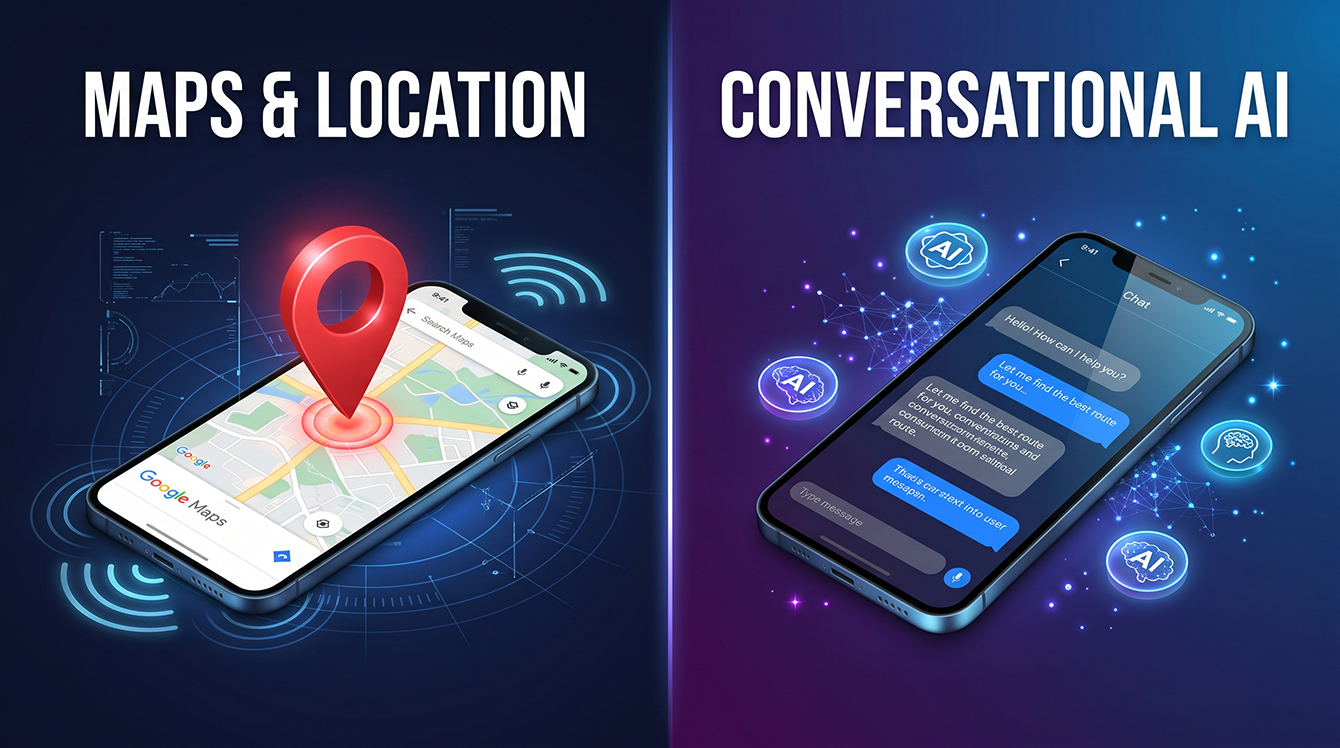
The way consumers find and choose businesses is changing rapidly. For over a decade, local search directories have dominated the market. Leading this space is the Google Business Profile, formerly known as Google My Business. GBP was designed to put local companies on the map. It helps customers find nearby stores quickly. Users can easily check operating hours and get driving directions. It remains an essential tool for gaining local visibility.
Now, the digital landscape has shifted with the rise of generative AI. OpenAI introduced its Businesses in ChatGPT beta in November 2026. This platform takes a fundamentally different approach to search. Instead of a map-based directory, it acts as an AI-native storefront. Customers do not just look at a list of local businesses. They engage in deep, conversational research. They ask the AI to recommend specific products. They want to compare services and summarize return policies.
Both platforms let organizations claim a verified digital presence. This verification process is absolutely crucial for your success. It ensures the AI and search engines use accurate facts. Both platforms allow owners to lock in their core business facts. You can secure your name, address, phone number, website, and hours. It stops platforms from relying on scraped, third-party guesses. By securing your official data, you capture high-intent customer discovery.
However, the management of these platforms is quite distinct. With Google, you use the familiar Google Business Profile Manager. You verify your location with a video, phone call, or postcard. This process proves your physical and operational legitimacy. On the other hand, OpenAI uses the new ChatGPT Business Hub. Verification here involves domain and store checks. This process often includes a quick three-step Shopify integration. Completing this awards your brand a coveted blue checkmark.
While they look different, the core goal remains very similar. Both aim to connect active buyers with verified businesses. Claiming and maintaining a basic profile is free on both platforms. The challenge is that they capture users at different funnel stages. GBP captures users looking for an immediate local solution. ChatGPT captures users deep in conversational research and digital discovery.
OpenAI explicitly states that claiming a profile does not guarantee higher placement. It will not buy preferential recommendations in ChatGPT's independent answers. This mirrors Google's rule perfectly. Verifying a GBP improves data accuracy without automatically buying top rankings. You still need a strong overall digital strategy to stand out.
Section 2: Conversational Commerce vs. Local Geographic Intent
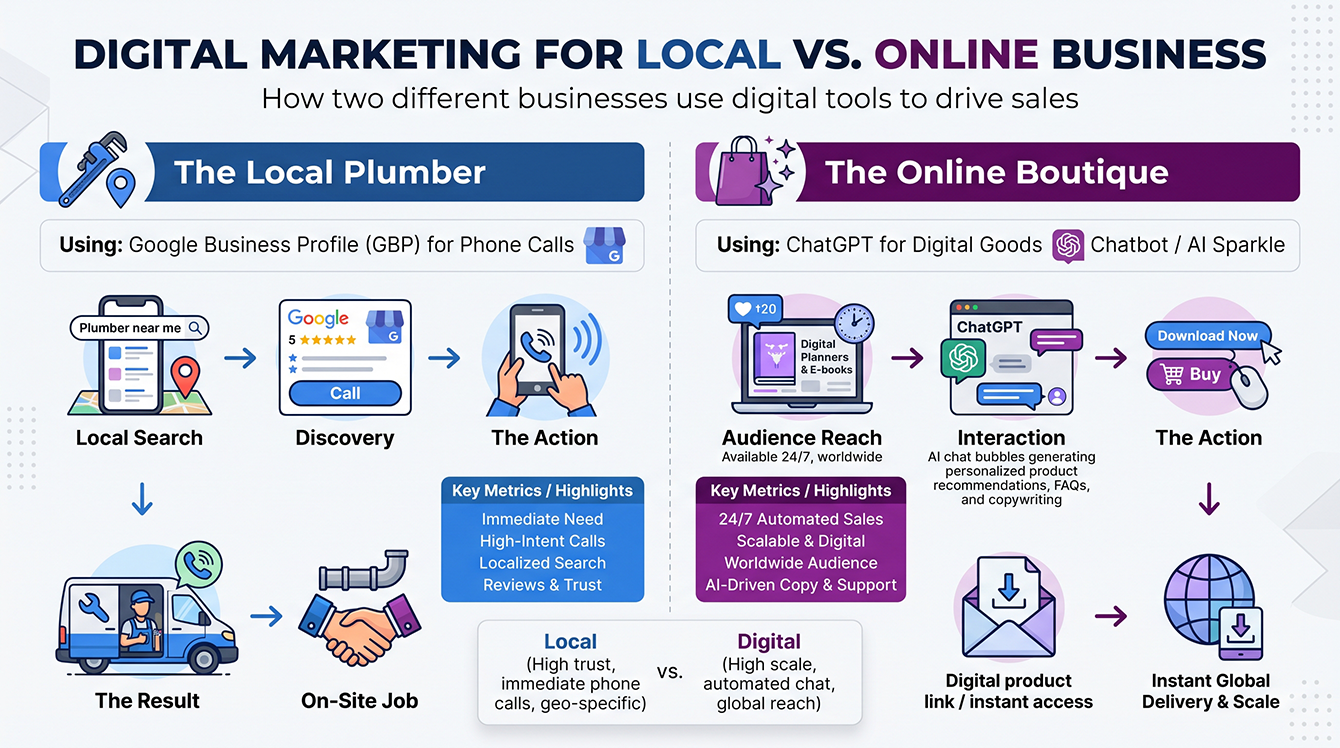
When you optimize business for ChatGPT, you must understand its unique focus. It is built entirely for conversational commerce. It excels in ecommerce, digital services, and online discovery. Users ask complex questions about product features. They want to understand detailed return policies. The AI provides detailed, conversational answers based on your catalog. This makes ChatGPT highly effective for brands selling products online.
Conversely, Google Business Profile is heavily optimized for local geographic intent. It is built for brick-and-mortar storefronts and local service providers. Customers use Google Maps to find businesses near their location. They want to know if a store is currently open or busy. They want a button to call the business directly. GBP delivers all of these hyper-local features flawlessly.
This difference becomes extremely clear when looking at service-area businesses. Many local trades, like plumbers or mobile contractors, work from home. GBP supports these businesses by hiding their residential addresses. It allows them to display a service area instead. This keeps the home address private while still capturing local leads.
Unfortunately, ChatGPT currently struggles with this specific concept. The ChatGPT Business Hub requires displaying a street address. There is currently no option to hide it for service areas. This makes it less tailored for home-based local trades than GBP. If you are a mobile mechanic, you may not want your address public. For now, GBP is much better suited for those specific local needs.
Furthermore, the level of allowed detail varies greatly. GBP has matured over more than a decade. It supports rich local attributes like wheelchair accessibility and Wi-Fi. You can add multiple secondary categories and promotional Google Posts. Because Businesses in ChatGPT is still in early beta, it is restrictive. It enforces a strict 300-character description and truncates longer text.
ChatGPT also limits you to just one single business category. Media options are currently quite limited on the new platform. ChatGPT crops all photos to a square from the center. The first photo acts as your cover, with no dedicated logo slot. Google, however, supports categorized photos, videos, and dedicated logo slots. Knowing these limits helps you tailor your content strategy effectively. You must be incredibly concise on your ChatGPT profile.
Section 3: The Game Changer: Interactive Business Agents
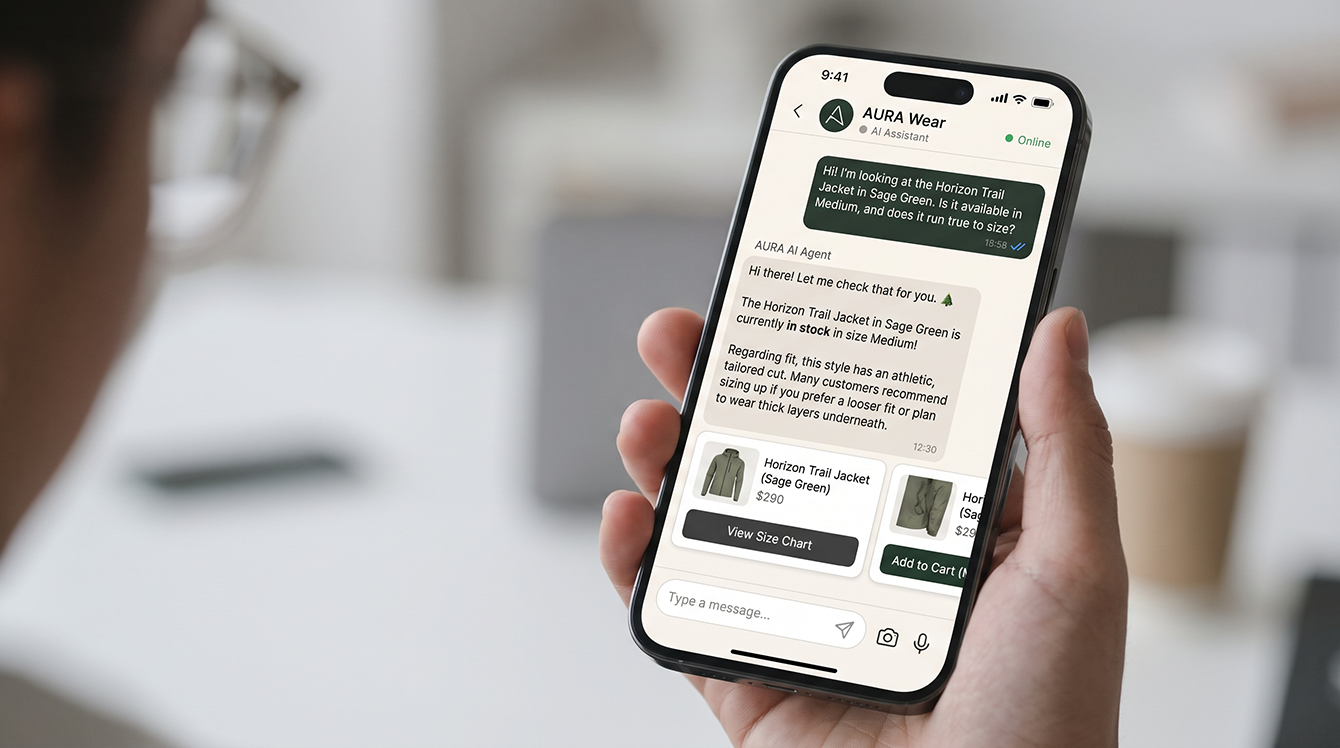
One of the most exciting developments is the rise of interactive assistants. The standout feature of OpenAI's new offering is the Business Agent. This feature is currently available for eligible US ecommerce brands. When a user clicks a claimed brand in ChatGPT, a conversation begins. They launch a separate, clearly labeled chat directly with the agent.
This agent uses business-approved guidelines and live product feeds. It can compare different models and explain your shipping rules. It handles complex customer queries with ease. If a customer is ready to buy, the agent acts fast. It links directly to the merchant's checkout page. It acts as a dedicated, 24/7 digital sales assistant.
This level of interaction goes far beyond a static directory listing. It completely changes the way consumers shop and research online. It creates a frictionless path from discovery to direct purchase.
For a long time, GBP only offered static interactions. Businesses had owner Q&A sections, booking links, and direct phone buttons. Google also offers Google Posts for promotional updates. However, Google is certainly not sitting still in the AI race. Recently, Google started rolling out AI-powered messaging for GBP users. Eligible businesses can now activate an AI agent powered by Gemini.
This integration brings conversational AI directly to local search profiles. The new Gemini integration automatically handles incoming customer messages on Google. If a customer asks a complex question, the system flags it. It segments conversations into automated threads and those requiring human attention. Business owners can seamlessly take over the chat manually if needed.
Both platforms are racing to perfect AI-driven customer service. OpenAI offers deep conversational product research through structured catalogs. Google offers AI-powered local messaging to convert map searchers into clients. Embracing these agents is critical for modern business owners. They save time, improve customer response rates, and drive sales constantly.
Section 4: Trust and Social Proof: Crowd-Sourced Reviews vs. Structured Catalogs
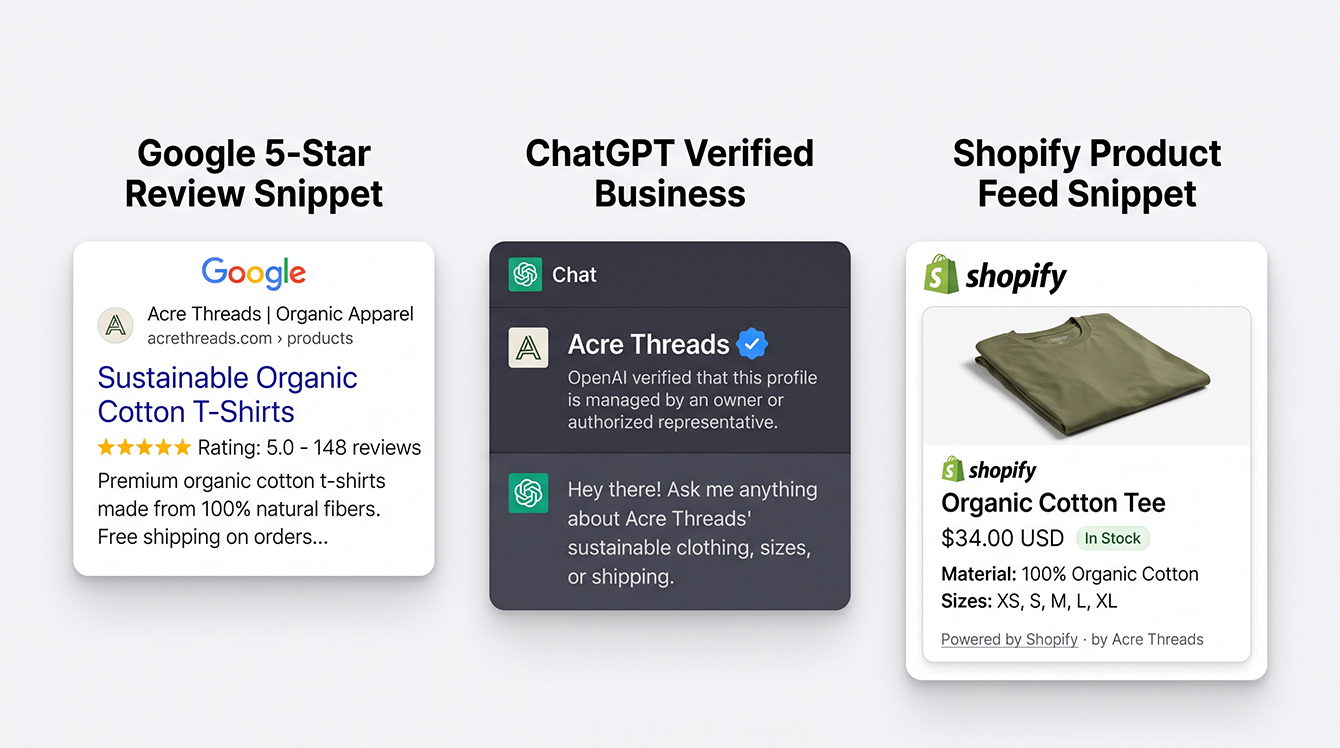
Trust is the ultimate currency of the modern digital marketplace. However, how these two platforms measure and display trust is fundamentally different. On Google, customer reviews are absolutely essential for success. Star ratings and written reviews are central to consumer trust. They heavily dictate both click-through rates and local pack visibility.
When a user searches on Google Maps, they instantly see star ratings. A business with a 4.8-star average and hundreds of reviews stands out. It naturally attracts more clicks, phone calls, and foot traffic. If you lack reviews on GBP, you are practically invisible to searchers. Positive reviews are the lifeblood of local geographic intent.
In stark contrast, Businesses in ChatGPT currently has no native review mechanism. There are no star ratings displayed next to your business name. So, how does ChatGPT evaluate brands and build consumer trust? It relies heavily on structured product feeds and verified profile data. It also looks closely at broader web citations.
The OpenAI Business Agent uses your official Shopify catalog for accuracy. Native Shopify catalog sync supports physical and digital goods. You can also use self-service product feeds. The verified blue checkmark serves as the primary trust signal.
Even though ChatGPT lacks native reviews, your overall reputation still matters. AI models pull data from across the entire web. If customers write positive things about you online, the AI notices. It synthesizes this broader sentiment into its conversational answers. A strong online reputation makes the AI more likely to recommend you.
This brings us to a highly vital digital strategy. You must actively manage your customer experience and online feedback. This is exactly where LoyaltyLoop becomes your absolute greatest asset. LoyaltyLoop helps you gather feedback directly from your real customers. You can use our platform to consistently generate fresh, positive reviews.
Customers posting these positive reviews on Google boosts your local visibility instantly. Furthermore, a strong overall digital reputation ensures AI tools view you favorably. When you control your customer feedback, you influence local maps directly. You also influence how AI business discovery tools perceive your brand. You simply cannot ignore the power of a happy customer's voice.
Section 5: Measuring Success: New AI Analytics vs. Traditional Local Metrics
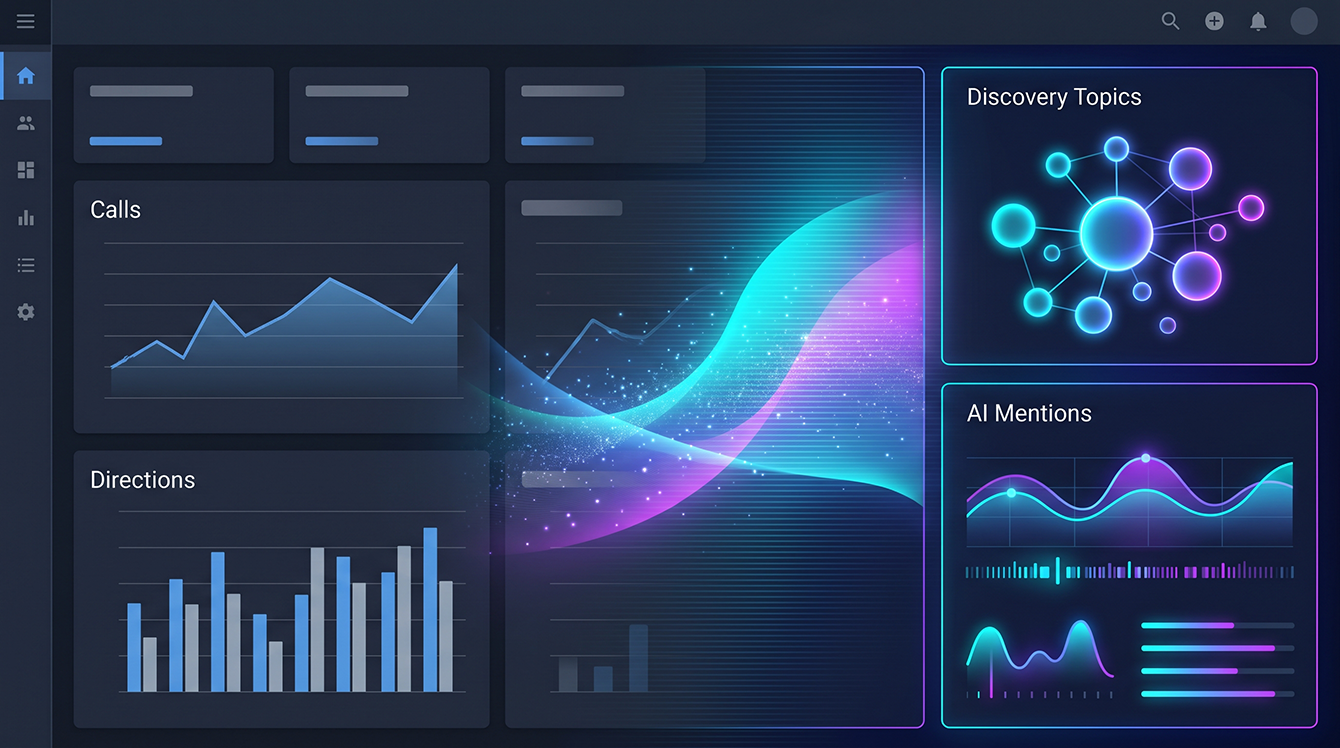
As a business owner, you need to know if your marketing works. Analytics provide the definitive proof you need to make decisions. Because these platforms serve different purposes, they track entirely different user actions. Understanding these metrics is key to measuring your digital success accurately.
Google Business Profile offers highly traditional local intent metrics. When you look at your GBP insights, you see actionable local data. You can track exact search queries that triggered your local listing. You see how many people requested driving directions to your store. You can count the number of direct phone calls generated. You also see profile views and direct website clicks. These metrics clearly show how your listing drives physical foot traffic.
On the other hand, the ChatGPT Business Hub introduces completely new metrics. These metrics are built specifically for generative search. It focuses on how your brand fits into conversational AI discovery. You can track total brand mentions in AI responses. You can see how many users clicked through to your website. You also gain insight into total profile views within the AI.
Most interestingly, ChatGPT introduces "discovery topics". These are aggregated conversation themes. They show exactly what users were researching when your business was cited. For example, you might see users discussing "sustainable packaging." This might be the conversation topic leading directly to your brand. This gives you incredible insight into user intent and conversational trends.
Both platforms are deeply committed to privacy-preserving first-party metrics. They provide excellent aggregated engagement totals. This means you can see the broad trends and action counts. However, they keep individual user identities and private queries completely hidden. You get the data you need to grow without compromising consumer privacy.
As AI search grows, tracking these discovery topics will become vital. It will become just as important as tracking local phone calls. You need to know both what people search and what they ask.
Section 6: Setting Your Brand Up for Success
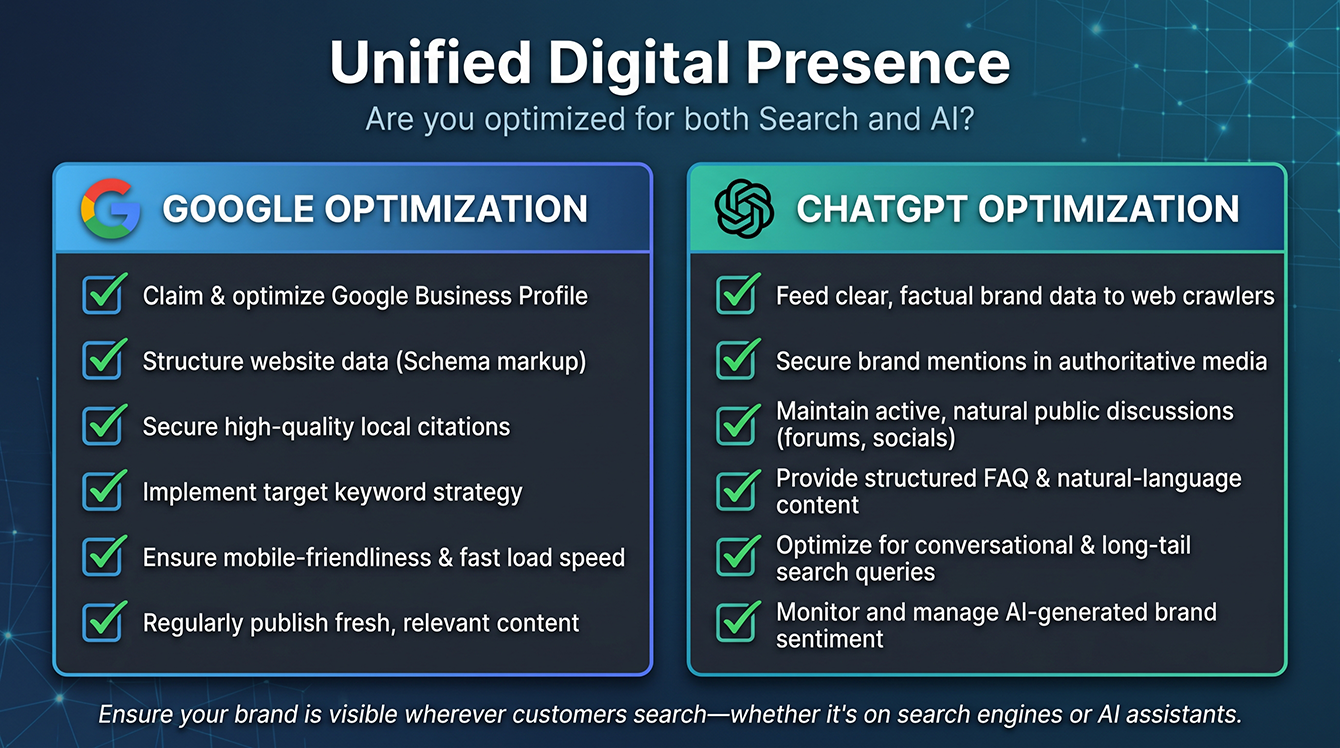
The digital landscape is no longer just about optimizing for search engines. It is about preparing for generative AI and interactive digital discovery. So, when looking for Google Business Profile alternatives, reconsider your strategy. You should not simply choose just one platform to focus on. You need a unified strategy that embraces both platforms fully.
First, establish a "Verified Source of Truth" across the web. Ensure your Name, Address, and Phone number (NAP) are always consistent. Maintain accurate operating hours and website links on both platforms. This consistency prevents AI models from getting confused by scraped data. It ensures platforms draw from official data, not third-party guesses.
Second, claim your profiles immediately on both networks (claim your: Google Business Profile, ChatGPT Businesses). Claiming a basic presence is completely free on both platforms. Just like on Google, verifying your data prevents online misinformation. It ensures your customers always find the right details easily.
Ultimately, most businesses need both profiles to truly thrive today. Use Google Business Profile to capture immediate local foot traffic and calls. Use Businesses in ChatGPT to capture high-intent digital shoppers researching online. By balancing both, you capture the entire modern customer journey effectively.
Managing your reputation across these growing channels can feel incredibly overwhelming. That is exactly why we proudly built the LoyaltyLoop platform. We make it easy to automatically capture real customer feedback consistently. We help you generate glowing online reviews from your happy buyers.
By keeping your Google reviews fresh and positive, you dominate local search. By improving your overall customer experience, you ensure AI agents recommend you. By capturing real customer testimonials you can display on your website, AI tools can add this context to your overall reputation. Are you ready to take control of your digital reputation today? Do not let poor reviews or a lack of feedback hold you back.
Put AI Discovery to Work with LoyaltyLoop
Schedule a Demo today with our expert team! See exactly how we can transform your customer experience into your best marketing tool!
Schedule a DemoFAQs About ChatGPT Businesses vs Google Business Profile
Q: Can I use ChatGPT Businesses if I don't have a physical store?
A: Yes, ChatGPT Businesses is highly optimized for online discovery and ecommerce. However, it currently requires displaying a street address for verification. It does not yet allow service-area businesses to hide their address.
Q: Does OpenAI charge for a ChatGPT Business profile?
A: No, claiming and maintaining a basic profile on the platform is free. This is very similar to a standard Google Business Profile. There are optional paid advertising layers available separately on both platforms.
Q: Does Google have an AI agent for my Business Profile?
A: Yes! Google recently introduced an AI-powered messaging agent using its Gemini technology. It can automatically handle incoming customer messages. It efficiently segments automated chats from those requiring human attention.
Q: How do reviews affect my AI rankings?
A: ChatGPT does not currently have native star ratings or written reviews. However, Google heavily relies on them for local map ranking. Furthermore, AI models look at overall web citations and broader sentiment. Strong reviews still boost your broader digital credibility significantly.
Q: What are "discovery topics" in ChatGPT analytics?
A: Discovery topics are aggregated themes showing what a user was researching. They show what users discussed before your business was actively cited. This helps you understand the conversational intent leading to your brand.