
Customer Advocacy: Definition, Roles, and Program ROI
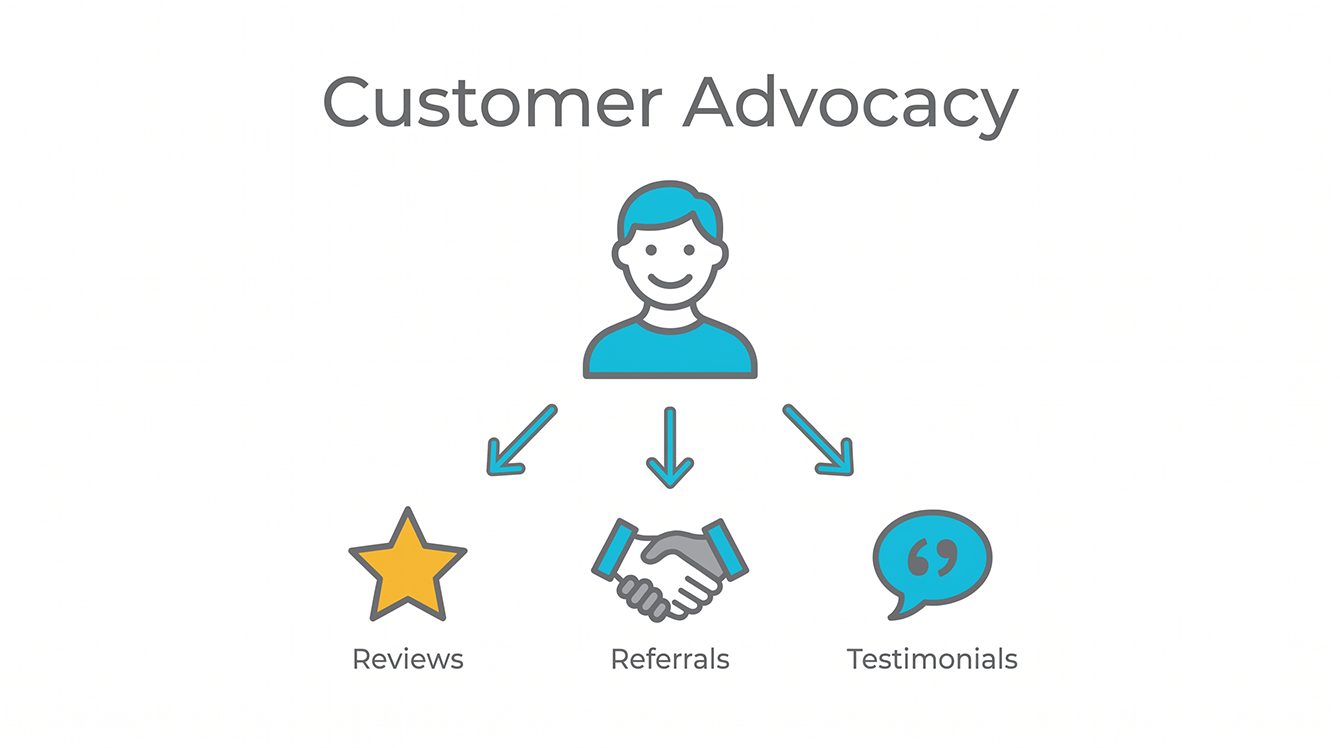
You finish the job, and the customer loves the outcome. Then weeks pass, and nothing happens. Nobody follows up, and nobody asks either. Referrals and reviews show up by accident, if they show up at all.
Customer advocacy fixes that. It's the work of turning happy customers into people who vouch for you. It covers the role, the program, and the revenue it drives.
The catch? Advocacy only works as an ongoing system with a named owner. Once it runs that way, you know who to ask and when. You can learn what the results are worth, too.
Main Takeaways
- There are internal and external advocates. Internal advocates share customer feedback with teams that can act on it, while external ones promote the business through reviews and referrals.
- Loyalty keeps customers buying, while advocacy asks them to tell someone. That second ask needs its own timing, owner, and follow-up.
- Advocacy works as a repeatable system. It needs a named owner, an identification method, defined timing, and follow-up rules.
- The strongest advocate signals pair sentiment with behavior. A past referral outranks a single high satisfaction score.
- Measure advocacy with leading indicators like Net Promoter Score℠ (NPS®) and review velocity. Then add referral revenue, upsell revenue, and lower acquisition costs to calculate return on investment (ROI).
What Is a Customer Advocate?
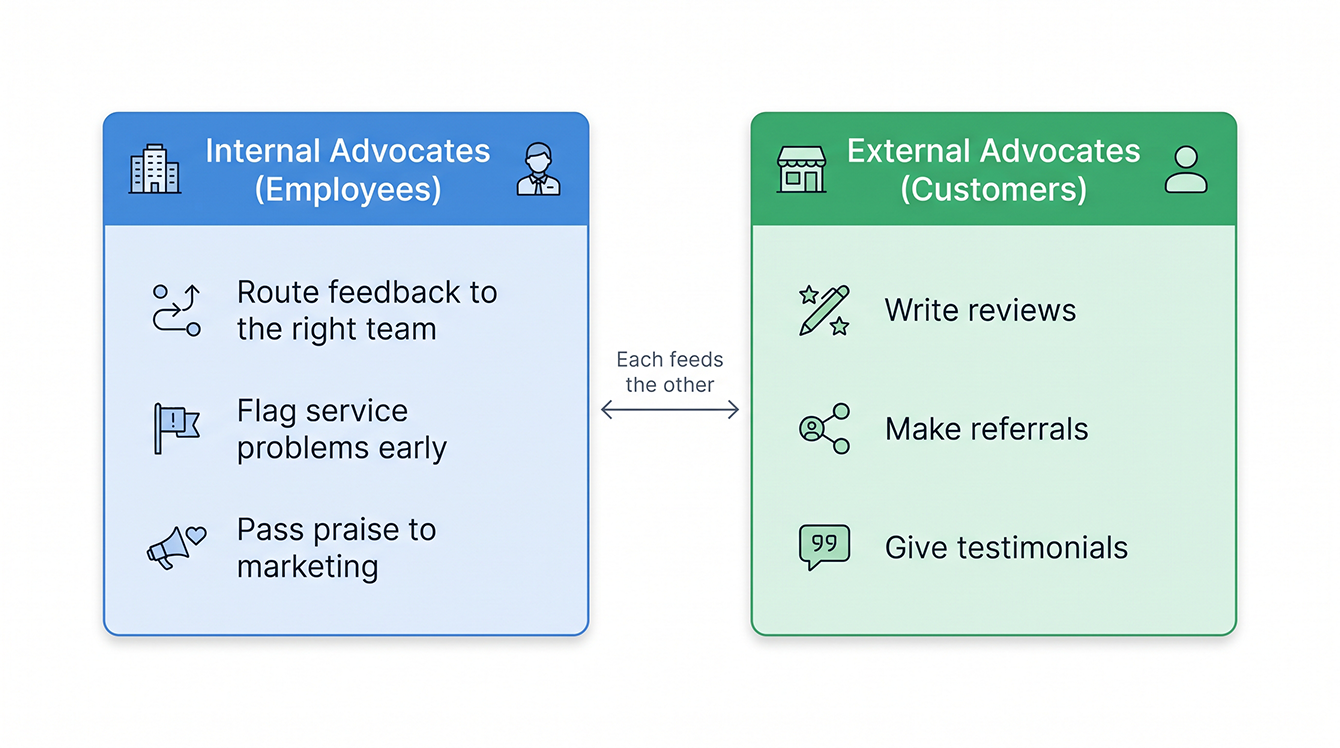
A customer advocate is someone, inside or outside your company, who speaks for the customer and helps others choose you. Internal advocates are employees. They route feedback, coordinate fixes across teams, and pass praise to marketing. External advocates are customers. They write reviews, make referrals, give testimonials, and help other buyers.
Internal Advocates
An internal customer advocate brings the customer's voice into the room where decisions get made. That person usually works in support, customer success, or customer experience (CX). Their job is to make sure product, operations, and leadership hear what customers actually said.
The daily work is practical. They collect feedback and send it to the team that can act on it. They flag service failures before a frustrated customer walks away. They spot patterns, like the same complaint showing up at three locations in one month. And they pass customer praise to marketing while it's still fresh.
The role reaches past customer service into customer experience. In a smaller business, the owner or an operations lead usually carries it. Most can cover it without a new hire, as long as one named person owns it.
External Advocates
An external customer advocate is a customer who promotes your business in public. They might leave a Google review or refer a neighbor. They might give you a testimonial, join a case study, or vouch for you to a peer. Nobody pays them to speak up. Their experience was good enough that they're glad to say so.
The type of advocate you're building for shapes the whole program. Internal advocacy runs on process and teamwork between groups. External advocacy runs on spotting the right customers, asking at the right moment, and following up. The two feed each other, because internal advocates create the experience that turns buyers into external ones. Either way, the work needs an owner who understands what the role asks of them.
Why Does Customer Advocacy Matter?
Advocacy feeds the three numbers operators watch closest: new customers, kept customers, and lower acquisition costs. Your existing customers can become a steady source of referrals, reviews, and revenue. Paid ads can't deliver that at the same cost.
Referrals pay off far out of proportion to their volume, too. Promoters who actually recommend a company make up about 15% of its customer base, according to NPS Prism. Yet their referrals drive 72% of new-customer profit over three years.
Small businesses lean on this even harder. In LocaliQ's 2026 marketing trends report, 83% of small businesses called customer referrals their best source of new customers, up from 65% the year before.
Reviews also decide whether people find you at all. According to Google's Business Profile guidelines, more reviews and positive ratings can help your business's local ranking. A stale review profile costs you customers before they ever call.
Not to mention, the same system that asks for reviews also listens for trouble. When a survey surfaces an unhappy customer, you get a chance to fix things before they leave (or leave a bad review). That early warning protects revenue you've already earned.
Customer expectations are also climbing again. Forrester's 2026 CX Index showed the first year-over-year rise in US CX quality since 2021, with 26% of brands improving and just 7% declining. When competitors are getting better, the business that doesn't follow up often falls behind.
Customer Advocacy vs. Customer Loyalty
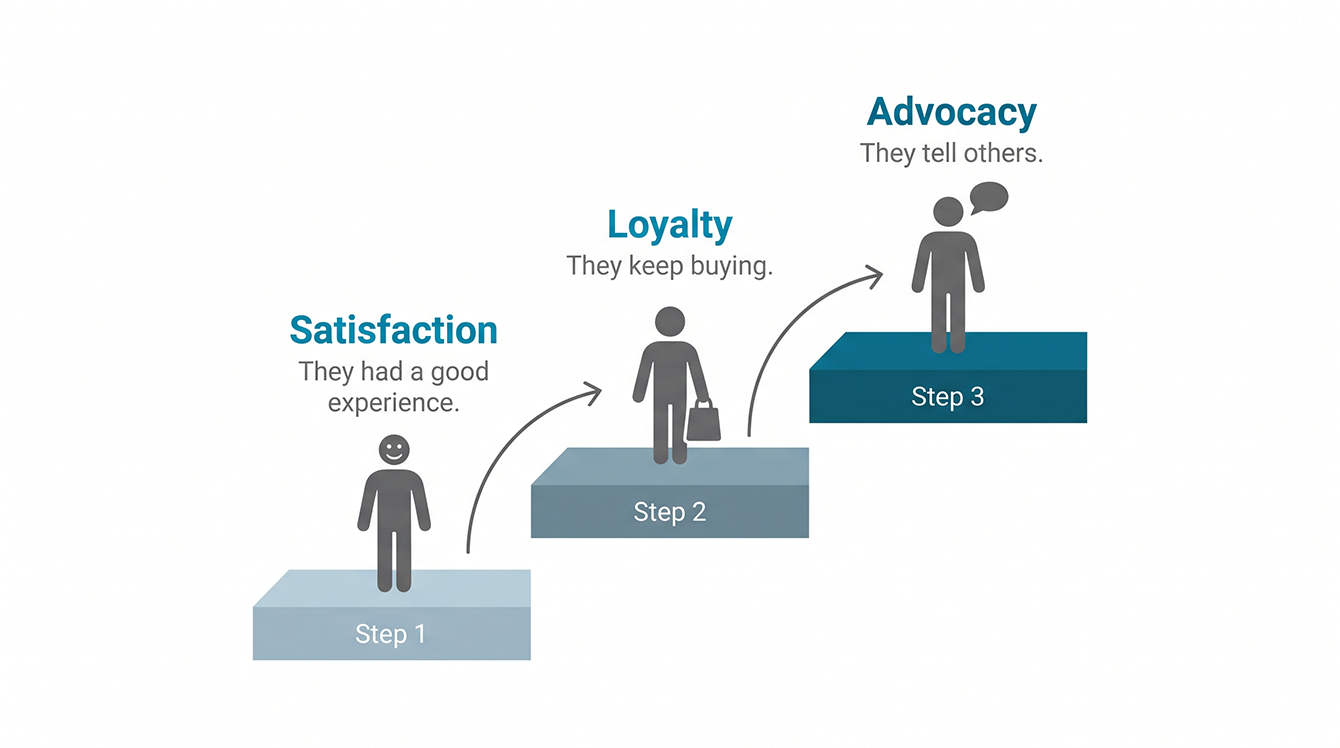
Customer loyalty keeps your current customers coming back. Customer advocacy turns those customers into people who bring you new ones. A loyal customer keeps buying from you instead of switching to a competitor. An advocate goes further and promotes you where others can see it. They write a review, refer a colleague, agree to a case study, or recommend you to a peer.
A customer can stay loyal without ever becoming an advocate. Think of the client who renews every year but never mentions you to anyone. Advocacy is the step past loyalty, where satisfaction turns into public action.
The gap shows up in what you measure. Retention rate and repeat purchase frequency track loyalty well. Both miss the promotion behavior that actually grows your customer base. Loyalty asks customers to stay, while advocacy asks them to tell someone. That second ask requires a different approach than simply keeping customers around.
You can't build advocacy on a bad experience. Satisfaction comes first, then loyalty. Advocacy is what turns that stable customer base into growth.
How Customer Advocacy Works in Practice
Advocacy holds up when you run it as a repeatable workflow. It needs a named owner, clear triggers, and follow-up rules. A strategy you set once and leave alone stops running fast.
Think of it this way: a strategy gives you the to-do list. Ask for reviews, request referrals, and collect testimonials. A system makes those things happen week after week, long after the planning meeting ends.
Every working advocacy system has four parts:
- A named owner who's accountable for the workflow.
- A reliable identification method that tells you which customers to ask.
- Defined timing for when each ask goes out.
- Follow-up rules so an ask doesn't die after one attempt.
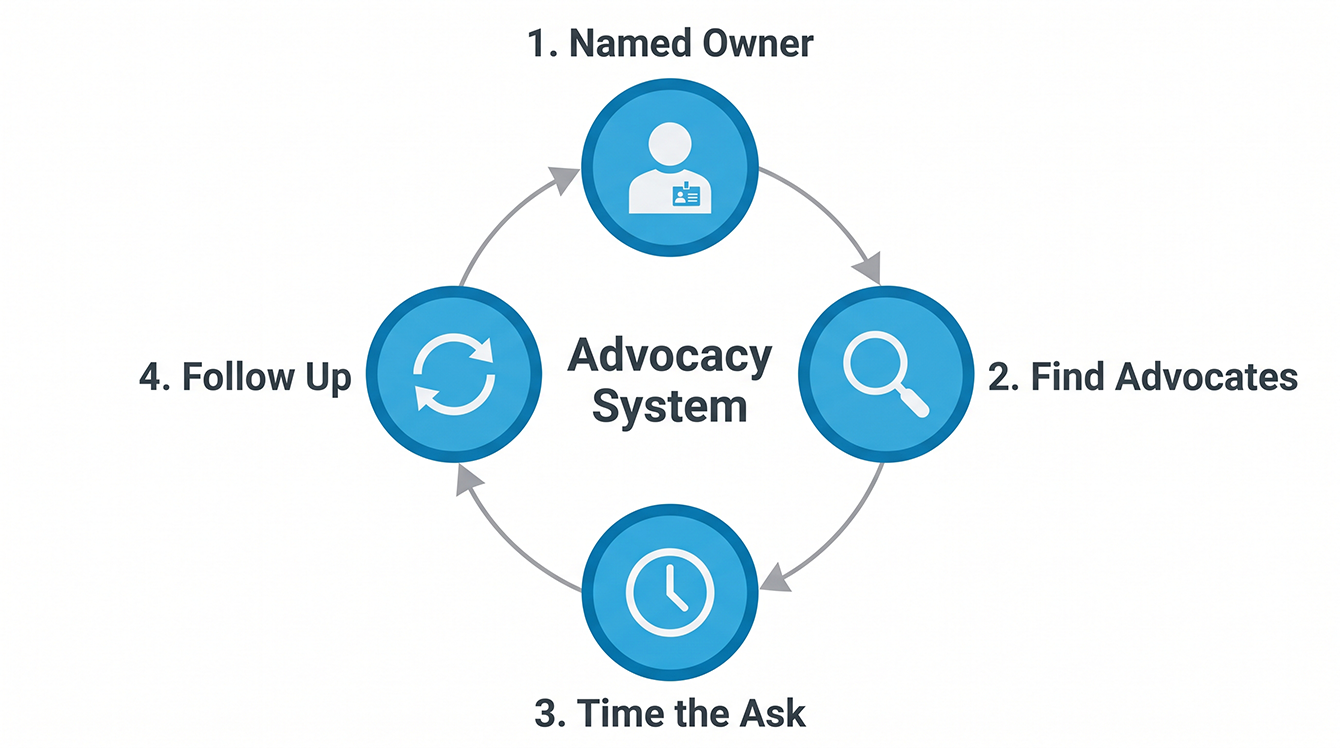
A system keeps moving on its own. Every customer gets a feedback survey after a transaction. Promoters also get a referral ask, ideally backed by a simple referral program. Unhappy customers get a personal follow-up. The owner watches results and makes adjustments, and nobody has to remember to start it.
Build the Experience That Creates Advocates
Advocacy starts with what customers feel before you ever ask them to refer anyone. These five CX elements show you where that feeling comes from.
How to Identify Customer Advocates
You find advocates by tracking specific signals in what customers say and do. "Happy customers" is too vague to act on. Plenty of happy customers will never write a review or send you a referral. To identify advocates, look at their actions alongside their feelings.
The strongest signals pair sentiment, meaning how a customer feels, with behavior, meaning what they've already done. A customer who has already referred someone sits at the top because the behavior is proven. A single high satisfaction score ranks lower because it reflects one moment.
Use these signals to decide who gets referral, testimonial, and case study asks.
| Signal | What It Tells You | Strength |
|---|---|---|
| Past referral history | Already demonstrated advocacy behavior | Strongest |
| Social mentions or unasked reviews | Public promotion without being asked | Strong |
| Positive open-text feedback | Unasked praise with specific detail | Strong |
| Net Promoter Score℠ (NPS®) 9–10 (Promoter) | High willingness to recommend | Strong |
| Repeat purchase / renewal history | Proven loyalty, but not yet promotion | Moderate |
| High Customer Satisfaction Score (CSAT) (4–5 / 5) | Satisfaction with recent interaction | Moderate |
Review requests run on their own schedule, apart from these asks. Never offer a perk for a review, and never tell customers what to write.
For referrals and testimonials, knowing who to ask solves half the problem. When to ask is the other half. The best time to ask is right after a good experience, while the feeling is fresh and specific. Wait a few weeks and the response fades. You don't have to read every survey by hand to catch these moments, either. Managed CX platforms can spot the signal and alert your team.
At LoyaltyLoop®, our Positive Feedback Alert fires the moment a customer gives an NPS response of 9 or 10. Your team can follow up while the moment is fresh with a referral ask or testimonial request. Over time, you build a running list of promoters to follow up with.
How to Build a Customer Advocacy Program
Building a customer advocacy program comes down to three stages, each with two jobs. You set goals and name an owner. You choose your asks and offer real value. Then you act on feedback and build follow-up rules that keep it running.
Set Goals and Name an Owner
Decide what you want advocacy to produce first. That might be more reviews, referral leads, testimonials for sales materials, case studies, or all four. Get specific. "More reviews" is a wish, while "15 new Google reviews per month across 4 locations" is a goal.
Then put one name on the program. That person won't do every task. They answer for whether the workflow runs and results get tracked. A good customer advocacy job description goes past launch duties. It covers monitoring satisfaction metrics and keeping follow-up rules current. It also covers reporting program ROI to leadership.
Choose Your Asks and Offer Value
Each advocate fits a different ask. A customer who left a glowing survey response and gave permission to share it is a strong testimonial candidate. A long-tenured business-to-business (B2B) client makes sense for a case study or reference call. Someone who has already referred a friend belongs in your referral program.
Value here has nothing to do with paying for praise. The FTC's 2024 Consumer Reviews and Testimonials Rule bans fake reviews and paying for reviews that express a particular sentiment. It also lets the agency seek civil penalties. Real value means making the ask easy and respecting the customer's time. It also means closing the loop on feedback they gave.
Act on Feedback and Build Follow-Up Rules
Acting on what customers tell you is what separates an advocacy program from a survey program. When a customer flags a problem, someone follows up. When a customer offers praise, someone sends it to marketing.
Every response type needs a defined next step. A complaint gets a personal follow-up. Praise earns a referral or testimonial ask. No response leads to a resend or a timing change.
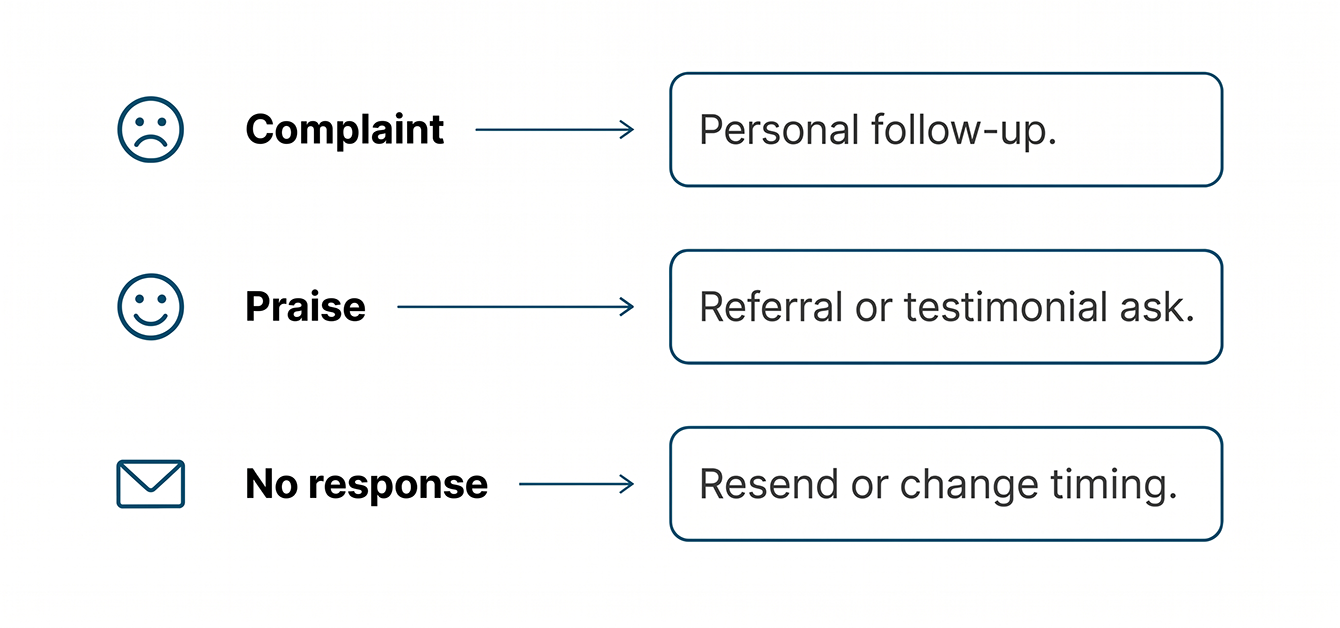
These rules should run on their own, with nobody needing to check a dashboard first. Each pass through the loop makes the program sharper.
B2B and Client Advocacy
Client advocacy is customer advocacy applied to B2B relationships. The principles hold, but sales cycles run longer, the asks carry more weight, and "customer" becomes "client."
At its core, client advocacy is a two-way commitment. A B2B company makes a habit of standing up for its clients' interests. In return, it earns the peer proof that wins new business. That means reference calls, case studies, third-party reviews, and personal referrals.
Agencies and managed service providers (MSPs) tend to prefer the word "client." Their relationships run for years, and each buyer is a named account they advocate for daily.
The asks change first. Instead of a Google review, you might request a case study or a reference call with a prospect. You might also ask for a G2 or Clutch review. Timing changes, too. B2B relationships move slowly, so you ask after a milestone like a smooth setup, a renewal, or a clear result. Every time your team steps up to advocate for client needs, you earn the standing to make that ask.
Peer proof carries extra weight with business buyers. In G2's 2024 Buyer Behavior Report, 31% of B2B software buyers said they consult review sites more than any other source. Buyers rated independent reviews above analyst firms at every stage of the buying process.
Customer or client, the system stays the same: find the right people, ask at the right time, and follow up. Only the asks and the proof assets change.
How to Measure Customer Advocacy
Measuring advocacy takes two kinds of numbers. Leading indicators show whether the program is producing advocates. Revenue metrics show what it's worth. Most programs stop before they reach the revenue side.
Leading Indicators
These five metrics tell you whether your advocacy system is producing the right inputs. Think of them as a health check on the program. They won't show a money return on their own.
| Metric | What It Measures | How to Calculate |
|---|---|---|
| Net Promoter Score℠ (NPS®) | Willingness to recommend | % Promoters - % Detractors |
| CSAT (Customer Satisfaction Score) | Satisfaction with a specific interaction | (Positive responses ÷ Total responses) × 100 |
| CES (Customer Effort Score) | Ease of doing business with you | Average score on a 1–7 effort scale |
| Review velocity | Rate of new reviews over time | New reviews per location per month |
| Referral volume | How often customers bring you new leads | New referred leads per month |
Program ROI
Program ROI links those inputs to dollars. Track how many referred leads become customers. Track the revenue those customers bring in. Add upsell and cross-sell revenue from advocate accounts. Then add any drop in customer acquisition cost (CAC).
The formula is simple: add revenue from advocacy-sourced customers, upsell revenue from advocate accounts, and CAC savings from referral-sourced leads. Subtract your total program cost. Then divide by program cost and multiply by 100 to get your ROI as a percentage.
Program ROI (%) = (Advocacy-sourced revenue + advocate upsell revenue + referral CAC savings − program cost) ÷ program cost × 100
Leadership funds what it can tie to revenue. Pair your NPS results with this formula, and you walk into the budget meeting with a real number. Track early signs like NPS, CSAT, and review velocity alongside late results like referred revenue and CAC savings. A simple monthly customer experience ROI scoreboard keeps both in one view for whoever controls the budget.
Turn Feedback Into Reviews and Referrals
Spotting advocates only pays off when the right ask goes out at the right time. See how a managed feedback program handles that workflow for you.
Why Do Customer Advocacy Programs Fail?
Most advocacy programs stall because nobody owns the workflow once it launches. Abandonment is the most common failure. Someone builds the program, sends the first round of requests, and moves on to the next priority. Without a named owner reviewing data, adjusting timing, and following up, the program goes quiet within weeks.
These are the five failure modes we see most often:
- No named owner: The program starts as a team effort and ends as nobody's job. Requests stop going out, and nobody notices until reviews dry up.
- Vague advocate criteria: "Happy customers" isn't a segment you can act on. Without signals like Net Promoter Score℠ (NPS®) responses, purchase history, and sentiment, you make referral and testimonial asks to the wrong people at the wrong time. Response rates drop as a result.
- Reward-only thinking: Paying for positive reviews breaks the FTC's 2024 rule, and Google's review policies prohibit offering incentives in exchange for posting any review. Leaning on rewards instead of a real feedback loop also produces shallow engagement that fades as soon as the reward does.
- Weak follow-up: One email doesn't make a system. Most customers who skip the first ask are simply busy. Clear rules for timing, channel, and frequency turn requests into responses. Skipping them leaves easy yeses on the table.
- No feedback action: Customers who give feedback and see nothing change stop giving it. Acting on what you hear earns the next ask, and ignoring it burns that goodwill.
Every item on this list is an operations problem. Ownership, process, and follow-through can fix each one.
Customer Advocacy Examples
These four examples show the system at work in business-to-consumer (B2C), B2B, and local service businesses.
Chewy sends handwritten sympathy cards to grieving pet owners. Sometimes it sends custom pet portraits. Customers post about these moments without being asked. That sharing brings in new buyers through word of mouth.
HubSpot builds advocacy through customer references, a steady case study pipeline, and the HubSpot Community, where customers answer each other's questions. That peer help takes load off support, and reference calls and case studies give sales proof to share.
Salesforce built the Trailblazer Community. Customers earn recognition for helping peers, making content, and speaking at events. Prospects hear from users who work with the product every day, which builds trust in big-company deals.
Now picture a home services company with several locations running a managed review and feedback program after service calls. Every customer gets a survey, and review requests go out on a steady schedule. Promoters also get a referral ask, and negative feedback gets a quick personal follow-up. Each site keeps a steady flow of reviews and referrals.
Industry and size vary across these examples. What they share is advocacy built into the daily workflow.
Put Your Customer Advocacy System to Work with LoyaltyLoop
Advocacy delivers repeatable results when four pieces are in place: a named owner, defined advocate signals, timed asks with follow-up rules, and revenue-based measurement. Most efforts fade because businesses run them as campaigns, with a burst of activity followed by silence.
Your next step is simple. Put one person in charge, use the signal table above to pick the customers worth asking, and track what their referrals and reviews earn. You can build that system yourself or hand it off. Either way, it has to exist.
If nobody on your team has the hours, let us do the heavy lifting for you. Our fully managed feedback program asks customers at the right time, flags who to follow up with, and puts your feedback, reviews, and referral activity in one dashboard.
See how a fully managed CX program turns happy customers into referrals, reviews, and revenue without adding internal overhead.
Let Your Advocacy System Run Without the Extra Work
Our team sets up your surveys, alerts, and follow-up rules for you. Setup is typically a single 45-minute onboarding call, and most businesses are live in under a week.
Schedule a DemoFAQs About Customer Advocacy
Q: How Do I Know If My Customer Advocacy Program Is Actually Working?
A: Your program is working when advocacy actions rise over time and you can trace new revenue to them. Check review velocity and referred-lead counts monthly, alongside your regular Net Promoter Score℠ (NPS®) results. Watch for signs of a stall, like flat review velocity, referral asks with no logged responses, or 30 days without anyone reviewing the data. Check referred revenue quarterly.
Q: How Many Customers Should I Ask for a Review or Referral at a Time?
A: Ask in a steady flow right after transactions. Referral asks go to your promoters. Rolling asks keep your reviews fresh. Cap how often you ask each customer, and space follow-ups so busy customers don't feel chased.
Q: Should I Offer a Reward in Exchange for a Review or Referral?
A: Never offer anything in exchange for a review. The FTC's 2024 rule bans paying for reviews that express a particular sentiment, and Google's review policies prohibit offering incentives in exchange for posting any review. Referrals follow different rules, so check with your own counsel before you tie anything to one. Either way, a well-timed, easy ask does most of the work.
Q: What Should I Do When a Customer Who Gave Me a Poor Score Is Also One of My Best Accounts?
A: Follow up personally within 1 to 2 days to fix the problem. Hold off on referral, case study, or reference asks until it's resolved. A well-handled recovery often builds a stronger advocate.
Q: Is a Customer Advocacy Program Worth It for a Small Business With No Dedicated CX Staff?
A: Yes, as long as one person owns the workflow and the program stays small enough for them to run. Advocacy needs a named owner and a repeatable process. You don't need a new hire for it. Start with reviews, referrals, and a monthly check. Then decide between building it yourself or using a managed service, based on the hours the owner can protect.