
What Is Loyalty Marketing? The 2026 Complete Guide
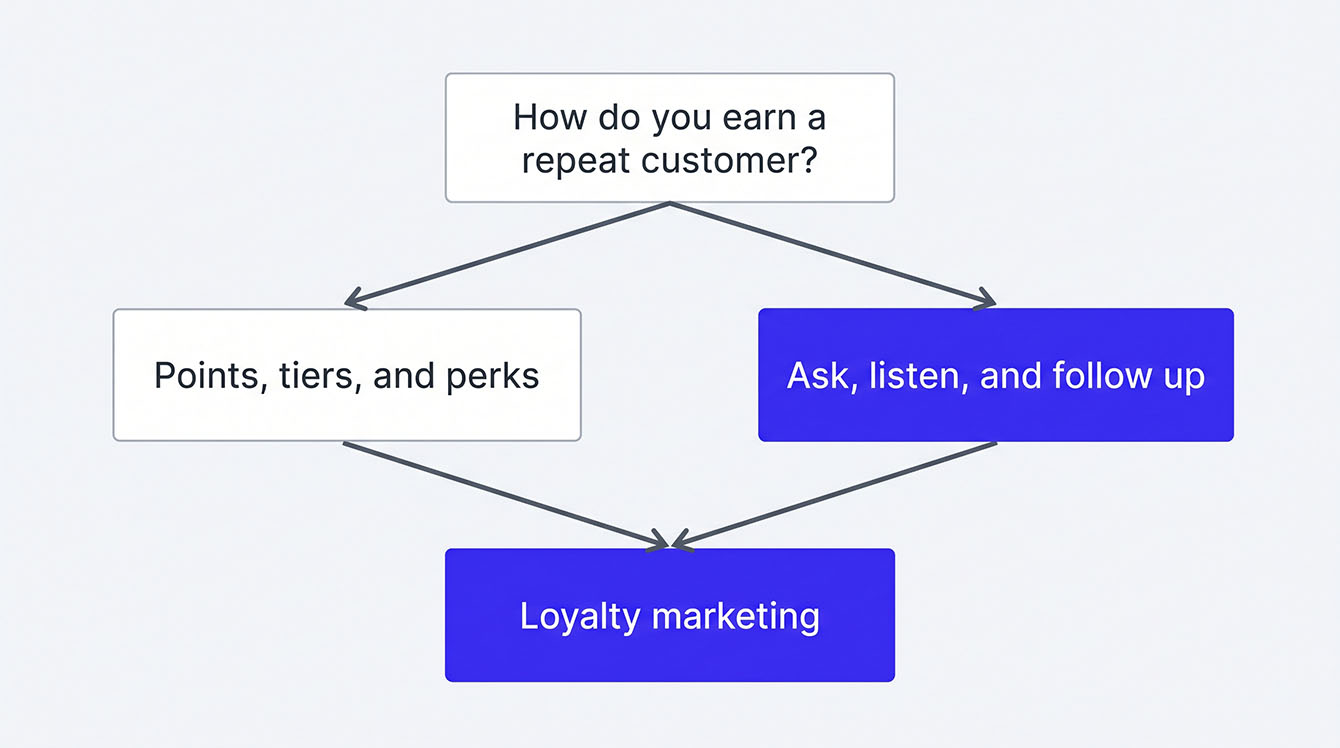
Say "loyalty marketing" and most people picture airline miles or a coffee-shop punch card. It sounds like something that requires a budget for discounts, freebies, and other incentives. If that's the version you've seen, you've probably written the whole category off. Don't. Loyalty marketing covers everything you do to earn a customer's repeat choice.
For a service business, that work starts after the transaction ends. You build loyalty by listening. You ask, you act on what you hear, and you close the loop. Read on to learn whether loyalty marketing fits your business without running a points program.
Main Takeaways
- A points program is one tactic inside loyalty marketing, which covers everything you do to earn a repeat choice.
- Loyalty programs come in four types: points-based, tiered, subscription, and feedback-driven.
- Build your strategy in five steps: define a goal, choose a program type, pick channels, set KPIs, then launch and iterate.
- Start measuring with Net Promoter Score℠ (NPS®) and churn rate, then add customer lifetime value, repeat purchase rate, and redemption rate.
- Loyalty marketing works without points or perks. Businesses can use a post-transaction feedback loop, dormant account outreach, and a referral program.
What Is Loyalty Marketing?
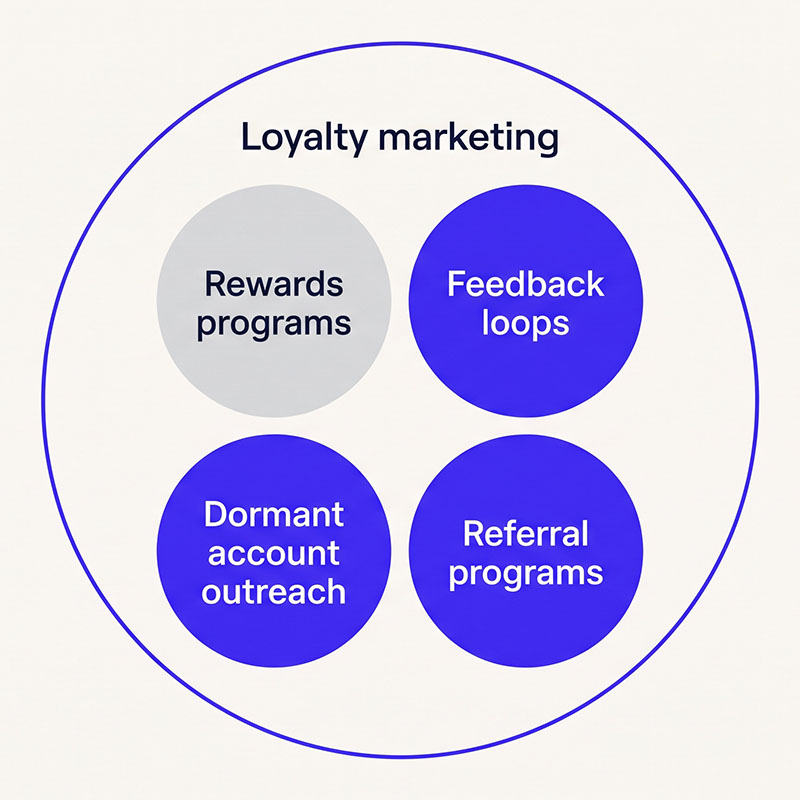
Loyalty marketing is the work a business does to earn repeat customers who come back by choice. It includes rewards programs, and it also covers customer feedback, service recovery, dormant account outreach, and referrals. Every form shares one goal: give custome rs a reason to choose you again.
Is Loyalty Marketing the Same as a Points or Rewards Program?
No. A loyalty program is one tactic inside loyalty marketing. Points, rewards, and other incentive schemes are one branch of a much bigger tree.
Why the Distinction Is Important
Points programs build loyalty by giving customers something to lose if they leave. A coffee shop might reward every tenth purchase, for example. Switching to another shop means giving up the progress made toward that free coffee. That's transactional loyalty, and it lasts only as long as the perks beat a competitor's.
That model doesn't translate well to a manufacturer, printer, or a managed service provider (MSP) with 30 accounts, or a professional services firm. Customers aren't necessarily making frequent purchases, and discounts may not give them a reason to stay.
For these businesses, loyalty often comes down to what happens after the service is delivered. Asking for feedback gives customers a chance to speak up. Acting on it shows that their experience matters. Reaching out to dormant customers helps rebuild relationships before they're lost. Together, these efforts build emotional loyalty, the kind customers feel when a business treats them well. Points penalize leaving, while listening rewards staying.
You don't need to reward customers for every purchase to earn their loyalty. You need to give them a reason to keep coming back.
Why Loyalty Marketing Matters in 2026
Loyalty marketing pays off in three ways you can measure:
- Higher customer lifetime value (CLV). Keep customers coming back and increase the value of each relationship over time.
- More first-party data. Learn directly from customers through feedback they're willing to share.
- More word-of-mouth growth. Turn strong customer relationships into referrals and recommendations.
Tighter budgets make customer retention even more important. Gartner found average marketing budgets fell to 7.7% of company revenue in 2024. With less money for acquisition, the customers you already have are worth more.
Every loyalty interaction also gives you a chance to collect first-party data. A survey response, a program signup, or a referral can all provide useful insights. That data matters more as customers grow protective of their information. Salesforce found that 71% of customers are more guarded about their personal data. Information customers willingly share helps you understand their needs without leaning on third-party tracking.
Those relationships can lead to more referrals, too. Customers who feel valued are more likely to recommend your business. That word of mouth brings in new customers without the same advertising costs, which makes it one of your highest-leverage growth channels. Acquisition starts from zero with each new customer, while loyalty marketing builds on the value you've already earned.
4 Types of Loyalty Programs (and One Most Businesses Overlook)
Loyalty programs come in four types: points-based, tiered, subscription or paid, and feedback-driven. You've likely seen the first three plenty of times. The fourth often gets overlooked, even though it works without a points currency or an app.
Points-Based, Tiered, and Subscription vs. Feedback Programs
Each type suits a different business model, asks a different amount of effort from customers, and gathers different data. What works for a business with frequent, smaller purchases may not make sense for one with fewer, higher-value transactions. Compare all four below to find the one that fits your operation before you build anything.
| Program Type | Best-Fit Business | Customer Effort | Data Collected | Retention Mechanic |
|---|---|---|---|---|
| Points-based | High-frequency retail, grocery, quick-service restaurant (QSR) | Low (earn passively) | Transaction history, purchase frequency | Accumulated perks discourage switching |
| Tiered | Hospitality, airlines, premium retail | Medium (spend to unlock) | Spend levels, engagement depth | Higher status and exclusive access reward continued spending |
| Subscription/paid | E-commerce, media, service bundles | Medium (pay upfront) | Membership tenure, usage patterns | Prepaid commitment and bundled benefits encourage repeat use |
| Feedback-driven | Service businesses, business-to-business (B2B), contractors, MSPs | Low (respond to surveys) | Satisfaction scores, service gaps, referral intent | Feeling heard and seeing problems resolved builds trust |
Feedback-Driven Loyalty: Why Listening Builds Retention
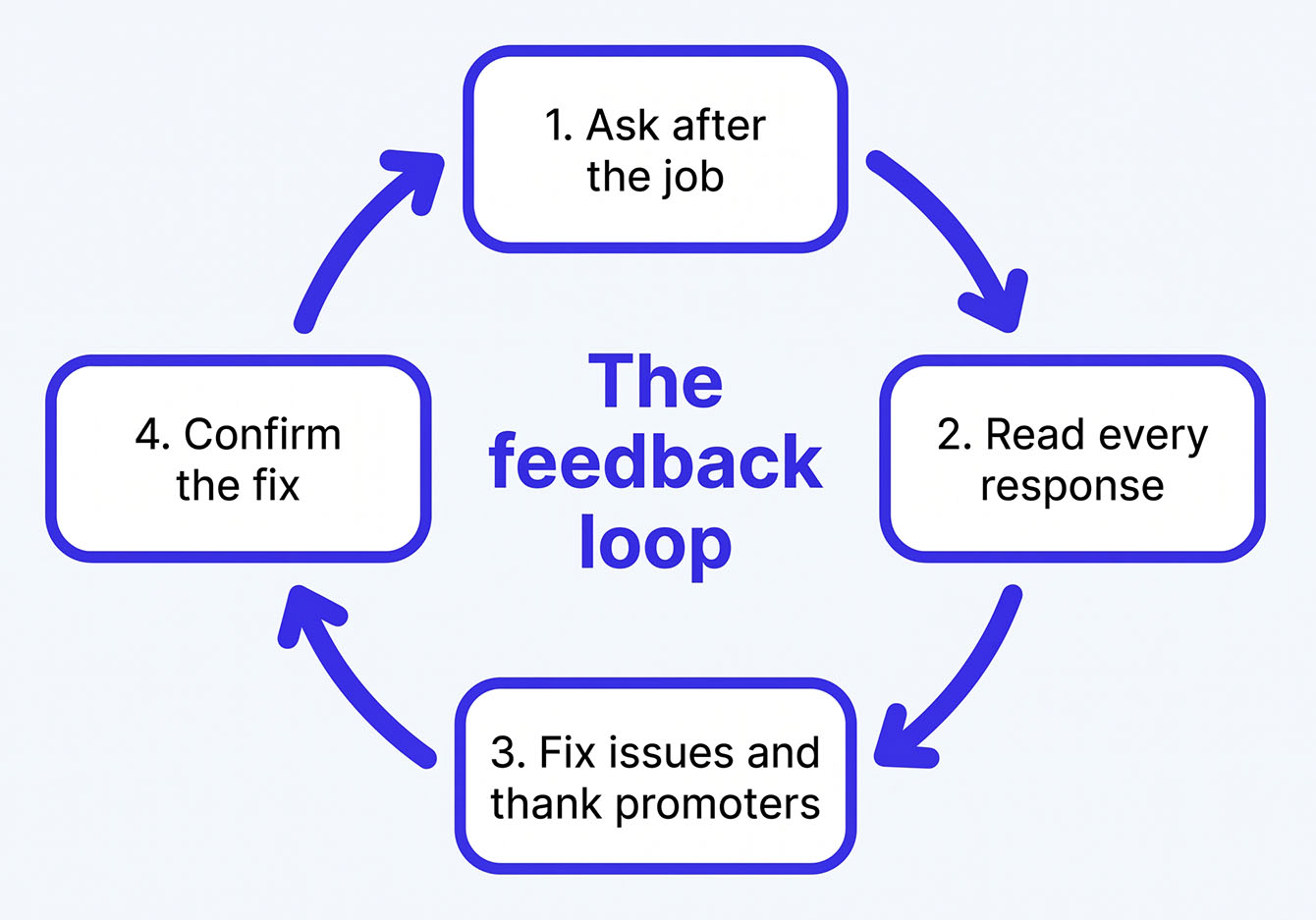
Feedback-driven loyalty means you collect structured feedback after transactions, act on it, and close the loop with the customer. That cycle builds loyalty in its own right. Fix a problem a customer flagged, and you've done more for retention than any points balance could. The customer insights you gain along the way are a bonus.
People who feel heard come back. Salesforce ranks poor customer service as the second most common reason customers stop buying from a brand. Flip that around, and a strong service recovery loop keeps them from walking. Our own customers at LoyaltyLoop® average 8 to 10 years with us through a managed survey program. We use no points, no tiers, and no app.
If your business runs on relationships and service quality, feedback-driven loyalty may fit you better than any incentive scheme.
Build Loyalty That Compounds Year After Year
Emotional loyalty keeps customers around long after a discount wears off. See the best practices operators are using in 2026 to keep customers coming back without a single punch card.
How to Build a Loyalty Marketing Strategy in Five Steps
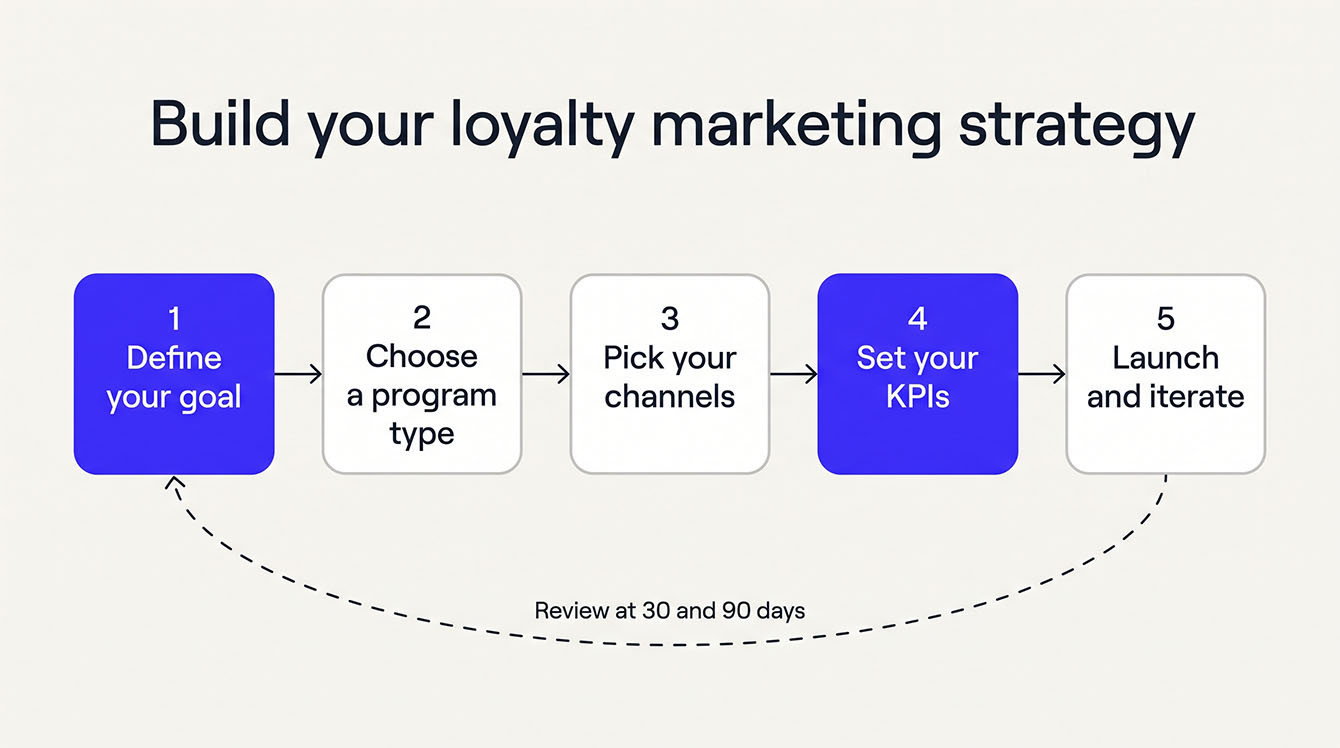
Building a loyalty marketing strategy comes down to five steps: define your goal, choose a program type, select your channels, set key performance indicators (KPIs), and launch and refine your program. Each step builds on the last, and the first and fourth matter most. Without a clear goal and metrics, it's hard to know whether your efforts are working.
Step 1: Define Your Loyalty Goal and Customer Segment
Start with the result you want to move. That might be a lower churn rate, more frequent repeat purchases, reactivated dormant accounts, or more referrals. Next, decide which customers matter most. Your highest-value accounts need different attention than your most at-risk ones. Your newest customers haven't formed a buying habit yet, so building that relationship requires its own strategy.
Step 2: Choose Your Program Type
Use the comparison table above to match a program type to your business model. A contractor tends to have no use for a points app. For service businesses, a feedback loop after completed projects is likely the highest-leverage move. A subscription e-commerce brand, on the other hand, might do well with a paid tier. Pick the type that fits how your business already operates, so the program adds value without adding work.
Step 3: Select Your Channels
Decide how you'll reach customers: email, SMS, in-app, or in person. For service businesses, an email after a finished job is the most natural touchpoint. The customer just worked with you, so the message lands while the experience is fresh. A quick-service restaurant might reach customers through its mobile app, where they're already placing orders and earning rewards. Whatever channel you pick should feel like an extension of the service.
Step 4: Set Your Measurement KPIs
Before launch, decide what you'll measure and how often you'll review it. At minimum, track Net Promoter Score℠ (NPS®), repeat purchase rate, and churn rate. If you run a points or tiered program, add redemption rate too. Settling this up front means you'll know from the first review whether the program is moving the needle.
Step 5: Launch and Iterate
Roll out to a subset of customers first, then review your KPIs at 30 and 90 days. Adjust based on what customers tell you through survey answers and behavior. Watch what they leave unsaid, too, since a once-active account going silent is a signal. Staying responsive matters: PwC found 46% of executives expect their current loyalty program to be irrelevant within three years. Keep refining your approach to meet customers' changing needs.
Loyalty Marketing Examples That Go Beyond Retail
Loyalty marketing looks different in each business model. The right approach reflects the kind of relationship you have with your customers. These three examples cover retail, subscription, and service. Each shows the method, the channel, and the outcome, so you can spot the pattern that fits yours.
Retail: Starbucks Rewards (Points-Based)
Starbucks Rewards is the textbook points-based loyalty program. Members earn Stars per dollar and redeem them for free food, drinks, and merchandise. They can also unlock higher tiers by spending more. Starbucks uses that purchase data to personalize offers, giving members more reasons to return. Each purchase tells Starbucks more about what its customers want, which helps drive repeat visits and higher CLV.
Subscription: Amazon Prime (Paid Loyalty)
Amazon Prime is paid loyalty at scale. Members pay a yearly fee for packaged perks like free shipping, streaming, and priority access. About 75% of U.S. households are Prime members, according to McKinsey. Over their lifetimes, those members spend more than 4x as much as nonmembers. In other words, the upfront fee changes behavior. Members shift more of their spending to Amazon to make the membership worthwhile.
Service Business: An MSP Using Feedback-Driven Loyalty
Picture an MSP with 30 managed accounts, no points currency, and no mobile app. Its loyalty method is a feedback loop. After a finished project or critical ticket, it sends a short survey. The team reads each response and follows up. They thank promoters and handle detractor concerns early. They also check on quiet accounts. That loop is the loyalty program. It catches at-risk accounts before they churn and turns happy clients into referral sources, without a single loyalty reward.
All three approaches share the same goal: earning a customer's repeat choice. Each just takes a different path to get there.
How to Measure Whether Your Loyalty Marketing Is Working
Five KPIs show whether your loyalty marketing is working: Net Promoter Score℠ (NPS®), CLV, repeat purchase rate, churn rate, and redemption rate. Many companies struggle here. PwC found 83% of executives need better tools to understand what drives purchases. For each metric below, you'll get a definition, a formula, and a sense of what good looks like.
Net Promoter Score℠ (NPS®)
NPS measures how likely your customers are to recommend your business to others, which makes it a useful gauge of loyalty. Start by asking, "On a scale of 0 to 10, how likely are you to recommend us?" Customers who answer 9 or 10 are promoters, 7 or 8 are passives, while those who answer 0 to 6 are detractors. To calculate your NPS, subtract the percentage of detractors from the percentage of promoters: NPS = % Promoters − % Detractors
What counts as a good score depends on your industry, so outside benchmarks only go so far. Tracking your NPS over time tells you more than any single score. A rising score means more customers are willing to vouch for you.
Customer Lifetime Value (CLV)
Customer lifetime value (CLV) estimates the total revenue a customer brings in across the whole relationship. Here's a simple way to calculate it: CLV = Average Purchase Value × Annual Purchase Frequency × Average Customer Lifespan (Years)
Say your average purchase is $500, customers buy 4 times a year, and they stay 5 years. That's a CLV of $10,000. Check it quarterly. A rising number is a strong sign your loyalty marketing is working.
Repeat Purchase Rate
Repeat purchase rate is the share of customers who buy from you more than once in a set period. The formula is simple: Repeat Purchase Rate = (Customers with 2+ Purchases ÷ Total Customers) × 100
What counts as healthy depends on your business model. Service businesses on contracts should see a much higher rate than retailers, so compare against your own past periods. A rising rate signals that more customers are choosing to return, while a decline points to room to strengthen retention.
If you run a referral program, track referral rate the same way: Referral Rate = (New Customers from Referrals ÷ Total New Customers) × 100. It shows how much of your growth comes from customers vouching for you.
Churn Rate
Churn rate is the percentage of customers who stop buying in a given period, making it the mirror image of retention. Calculate it as: Churn Rate = (Customers Lost During Period ÷ Customers at Start of Period) × 100
Subscription and recurring-service businesses aim to keep monthly churn as low as possible. Tracking it helps you spot shifts in retention before they become larger problems.
Redemption Rate (Program-Based Loyalty)
Redemption rate applies to points-based and tiered programs. It shows the percentage of earned rewards customers actually use. You can calculate it using this formula: Redemption Rate = (Rewards Redeemed ÷ Rewards Issued) × 100
A low rate may signal that customers aren't finding enough value in your rewards. Look at which rewards go unused and consider adjusting your offers to encourage more participation.
You don't need all five metrics on day one. Start with NPS and churn rate, since they're quick to set up. They're also the first to show whether customers are drawing closer or pulling away. A customer satisfaction score on individual jobs can add another layer of insight once those are running. As your strategy develops, bring in other metrics that track progress toward your specific loyalty goals.
See How a Feedback Loop Replaces a Points Program
Service businesses run loyalty marketing without apps, tiers, or rewards catalogs. Evaluate the tools that catch at-risk accounts and turn satisfied clients into referral sources.
Loyalty Marketing for Service Businesses
MSPs, contractors, cleaning crews, restoration firms, and professional services firms can all run loyalty marketing. You need three things: a feedback loop after transactions, outreach to dormant accounts, and a referral program. Each keeps you connected with customers after the work is done.
Post-Transaction Feedback as a Loyalty Mechanic
You finish a job and ask the customer how it went. That question is the loyalty method. A structured survey, sent at the right time, gives you a running read on each account's health. A low score means you pick up the phone before the problem grows or the customer goes quiet. A high score is your moment to ask for a referral. It's one workflow that keeps customers engaged without points or rewards. That's the idea behind feedback-driven customer loyalty.
Dormant Account Reactivation and Referral Programs
A dormant customer is usually one nobody has contacted lately. Service businesses can miss out on repeat revenue when those relationships go quiet. Start by identifying accounts that haven't bought in 90, 180, or 365 days, then reach out with a reactivation campaign. It's a simple way to reconnect with past customers and give them a reason to return.
Referrals offer another way to grow those relationships. A recommendation from a contractor's customer to a neighbor can bring in a warm lead at little acquisition cost, far warmer than a retail referral code. That's part of the ROI of a strong customer experience: existing relationships help generate new business. Make referring easy. Ask right after a high Net Promoter Score℠ (NPS®) response, give customers something simple to share, and follow up.
These three habits work across the service businesses we work with, from single-location contractors to multi-location franchise networks.
Common Loyalty Marketing Mistakes to Avoid
Five mistakes sink loyalty programs more often than poor delivery does:
- Treating loyalty as discounting. Relying on coupons and incentives instead of building lasting relationships.
- Skipping measurement. Launching without clear KPIs to track whether your efforts are working.
- Ignoring signals beyond sales. Missing the feedback and behavior that reveal how customers feel.
- Failing to segment customers. Using the same approach for customers with very different needs.
- Choosing the wrong program type. Investing in a loyalty model that doesn't fit your business or customers.
Discounts can eat into your margins without building a stronger relationship. A 10% coupon might encourage one purchase, but it doesn't guarantee greater CLV. Skipping measurement creates another problem. If you can't tell whether churn is rising or falling, it's hard to know whether your loyalty marketing is making a difference.
Some of the clearest loyalty signals never show up in a sale. Feedback responses, unanswered surveys, and account inactivity can reveal changes in engagement that sales data alone might miss. Segmentation matters, too. Your highest-value customers shouldn't necessarily receive the same outreach as first-time buyers. And if you choose a program that doesn't fit, you risk spending money on tools your customers have little reason to use.
Avoiding these mistakes starts with a clear strategy. Know what you're trying to achieve before deciding which tools or tactics will help you get there.
How Much Does Loyalty Marketing Cost?
Loyalty marketing costs depend on the type of program you run. Rewards programs cost the most, since every point, perk, and free item has a price. Across 4,187 U.S. hotels, CBRE found loyalty fees averaged 2.2% of rooms revenue in 2024. Feedback-driven programs usually run on a flat monthly fee, so the cost stays the same as your revenue grows.
That 2.2% is a useful reference point for rewards programs. Your number depends on program type, industry, and whether you build in-house or go managed.
Cost-per-Outcome Framing
A percentage of revenue can't tell you whether the spend is worth it. Cost per outcome can. Divide your annual loyalty spend by the added repeat purchases, won-back accounts, or referrals it produced. If one retained account is worth more than a year of program costs, the program pays for itself.
Service businesses without the budget or staff to build a program can use a managed one instead. LoyaltyLoop's managed feedback program starts at $99 per month for your first location, plus a one-time setup fee. That covers your customer survey, review engagement, and hands-on onboarding with our team, so your team can focus on following up with customers.
Loyalty marketing can stay affordable and still work. To measure the ROI of your customer experience efforts, start with what you spend per customer retained.
Put Feedback-Driven Loyalty Marketing into Action with LoyaltyLoop
Loyalty marketing doesn't have to mean points, discounts, or rewards. For most businesses, it can be as simple as listening to customers, acting on their feedback, and following up to show you've heard them. Those steps build stronger relationships and give customers more reasons to return.
That's the approach behind LoyaltyLoop. Our fully managed feedback program keeps you connected with customers after the job is done. You see concerns before they grow and know which happy customers to thank. Higher plans add referral and dormant account engagement, so your team can stay focused on serving customers.
Ready to build loyalty without running a rewards program? See how LoyaltyLoop helps you strengthen customer loyalty through feedback.
Build Customer Loyalty Without the Extra Work
Growing customer loyalty doesn't have to mean managing another program yourself. See how LoyaltyLoop makes feedback-driven loyalty simple with a fully managed approach.
Schedule a DemoFAQs About Loyalty Marketing
Q: How do I know if my business is too small for a loyalty marketing program?
A: Business size doesn't decide fit. Your repeat-purchase pattern and contract structure do. A business with 30 accounts can run loyalty marketing as well as a 300-location chain. The key is choosing an approach that makes sense for your customers and the resources you have. Feedback-driven loyalty needs no app, points currency, or software stack. You can start with one survey and one follow-up habit.
Q: Should I start with a feedback loop or a referral program?
A: Start with the feedback loop. It shows you who's happy enough to refer and who needs a fix first. The best time to ask for a referral is right after a high Net Promoter Score℠ (NPS®) response, so feedback is your trigger. Switch the order only if you already collect satisfaction data reliably.
Q: How often should I survey customers without wearing them out?
A: Tie surveys to the customer relationship instead of every sale. Send one after a completed project, a resolved issue, or a set interval for repeat accounts. High-frequency customers shouldn't get over-touched. Skipping a survey beats sending a rushed one. Silence from an engaged account is a signal worth noting.
Q: What do I do when a customer's feedback is negative?
A: Contact the customer directly and promptly, before they post publicly or go quiet. Treat it as a chance to recover the relationship. Acknowledge the specific issue, say what you'll change, and confirm back once it's fixed. That's closing the loop. Track recurring complaints across responses to find causes in your operations.
Q: How long before I can tell if my loyalty marketing is working?
A: Expect early signals within 30 to 90 days, such as response rates and NPS patterns. Churn and CLV changes take two to four quarters to show up reliably. Review leading indicators monthly: response rate, detractor count, and follow-up completion. Review lagging ones quarterly. Longer sales cycles, like MSP or contractor accounts, need a longer window.