13 Best Reputation Management Tools in 2026, Compared
You bought the tool, got the login, and then nobody ever logged in. The dashboard sat there. The review count stayed flat. Six months later you're looking at a different tool, wondering if the category just doesn't work.
It works. But most reputation management tools fail for the same reason: nobody owns the program after purchase. Before you compare features or pricing, you need to answer a bigger question. Who's going to run it? The answer shapes which type of platform makes sense for your business.
The following guide gives you a clear split between managed and self-serve options, along with pricing wherever we could find it. You'll also get an honest look at what breaks when tools go unused.
Main Takeaways
- Monitoring tools track mentions. Management platforms generate reviews, manage listings, and run response workflows.
- Every management platform on this list except LoyaltyLoop® requires someone on your team to configure and maintain it.
- Pricing opacity is a signal: vendors that don't publish pricing require an enterprise sales process before you can judge fit.
- Per-seat pricing penalizes growing teams. Per-location pricing scales with your footprint.
- Tools fail in four common ways: no configuration, plateauing campaigns, silent integration breaks, and unanswered negative reviews.
Why Google Reviews Matter More Than Ever for SEO
Reviews don't just influence customers. They also help Google understand your business and improve your visibility in local results.
Reputation Monitoring Tools vs. Management Platforms
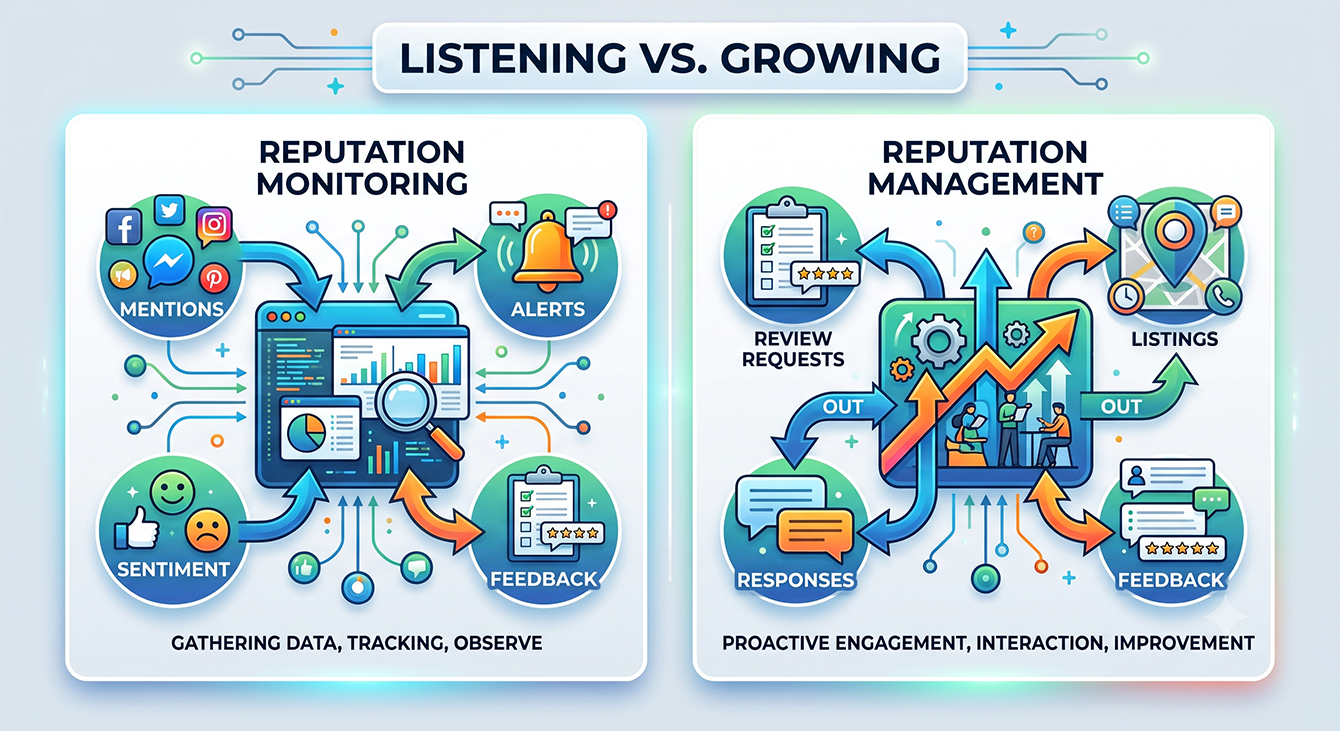
A reputation monitoring tool tracks brand mentions, alerts you to new reviews, and surfaces sentiment across channels. A management platform goes further. It generates reviews, automates response workflows, manages business listings, and routes feedback so you can shape your online presence.
Monitoring tools are a passive listening layer. They scan social media, news sites, blogs, forums, and podcasts for mentions of your business. Then they score each one for sentiment. Google even offers its own free option, Google Alerts, which emails you when Google indexes new content matching your brand name. This tells you what people are saying. It doesn't help you get more people to say it. It won't generate reviews, send review requests, manage listings, or provide response workflows.
Management platforms work differently. Birdeye and Reputation, for example:
- Send automated review requests via SMS and email
- Route customer feedback to the right team member
- Manage your business listings across hundreds of directories
- Give you workflows to respond to reviews at scale
These platforms require configuration and ongoing campaign management, which means someone on your team has to run them. Monitoring tools, on the other hand, mostly run on autopilot after initial setup.
Why This Distinction Matters Before You Compare Tools
Most roundups lump both categories together. That leads you to compare a lightweight alert tool against a full management platform and decide the whole category is confusing. The practical cost of that confusion is real. If you just need to know when someone mentions your brand online, a full management platform is overkill and overpriced. If you need more Google reviews, a monitoring tool won't get you there. (A third category, reputation repair services that suppress or remove negative content, solves a different problem entirely and sits outside this comparison.)
Either way, the platform you choose needs to focus on Google. According to BrightLocal, 81% of consumers used Google to read local business reviews in 2024. But generating and responding to those reviews? That's a management-platform function. Knowing which category you actually need cuts the field in half before you look at a single feature list.
How to Choose a Reputation Management Tool
The right reputation management tool depends on five things:
- What you actually need it to do
- Who's going to run it
- How pricing and contracts fit your size and structure
- What it connects to
- Whether it can handle multiple locations, if you have them
What Do You Actually Need?
Start with the monitoring-vs-management question. If you need review generation and response workflows, monitoring tools are off the list. Then narrow by specific function. Do you need review generation, listings management, sentiment analysis, or survey-based feedback? Most businesses reading this need review generation above all else.
After all, 69% of consumers recall leaving a review after being prompted, according to BrightLocal. The lever you can control for growing your Google review count is a platform that sends those prompts consistently.
Who Will Run It After You Buy It?
Most self-serve reputation management tools require someone on your team to configure campaigns, monitor results, adjust timing, and respond to reviews. If that person doesn't exist, or gets pulled to other priorities, the tool stalls and your review count stays flat. A fully managed program removes that requirement entirely.
The low-use pattern described earlier is the norm across purchased tools. If you have a dedicated marketing manager or agency partner, self-serve works. If you're an owner-operator wearing six hats, a managed program is the honest answer.
Wasted investment is only part of why program ownership matters. A 2024 BrightLocal study found that 88% of consumers would use a business that replies to all reviews. Only 47% would use one that doesn't respond. Knowing the answer to "who responds to reviews" is a revenue question.
Business Size, Pricing, Contracts, and Integrations
Your business size and structure determine which tier of tool makes sense. For instance, single-location businesses don't need enterprise platforms. However, franchise networks need location-level reporting and central visibility. Pricing model matters too: per-seat pricing like Sprout Social's penalizes growing teams. Per-location pricing like LoyaltyLoop's and BrightLocal's scales with your footprint.
Contract flexibility deserves more attention than most buyers give it, too. Delighted's shutdown in June 2026 left thousands of businesses rebuilding their feedback programs and is a reminder that vendor stability matters. Look for no-long-term-contract policies and data export before you sign. The tool must also connect to your existing systems, whether that's a CRM, POS, or industry-specific platform. Otherwise you'll be exporting CSVs by hand.
Reputation Management for Multi-Location Brands
Multi-location reputation is a structurally distinct challenge. The real issues include:
- Uneven review volume across locations
- No central visibility into location-level performance
- An accountability gap between corporate marketing and the operators running each location day to day
According to BrightLocal, 91% of consumers say local branch reviews shape their view of big brands in some way. A single underperforming location drags the whole brand. A multi-location reputation tool can help boost overall perception.
What to look for in a multi-location tool:
- Location-level dashboards that give each operator visibility into their own performance
- Central reporting that rolls up to a brand-level view
- The ability to manage dozens of Google Business Profiles without requiring each location to run its own campaigns
Reputation Management Tools Compared
The table below maps 13 tools across the dimensions most comparisons skip:
- Who has to run it after you buy it
- What it actually costs
- Whether a fully managed option exists
The columns surface day-to-day fit rather than feature coverage alone. Where a vendor doesn't publish pricing, the table flags "Pricing upon request" on purpose. Pricing opacity is itself a signal worth weighing. Google Alerts is included as the free baseline for businesses that only need basic mention tracking.
| Tool | Best For | Category | Requires Internal Operator? | Pricing | Managed Option? |
|---|---|---|---|---|---|
| LoyaltyLoop | Businesses without internal bandwidth to run the program | Management (Fully Managed) | No | Starts at $99/month per location; no long-term contract | Yes |
| Birdeye | Multi-location businesses with dedicated marketing staff | Management | Yes | Pricing upon request | No |
| Reputation.com | Enterprise brands with 50+ locations and a dedicated CX team | Management | Yes | Starts at $80/location/month | No |
| Sprout Social | Marketing teams already using Sprout for social media | Monitoring | Yes | Starts at $199/seat/month | No |
| BrightLocal | SEO agencies and local businesses focused on local search | Management | Yes | Starts at $31/month (review features from $40/month) | No |
| NiceJob | Local service businesses focused on automated review generation | Management | Yes | Starts at $75/month | No |
| Podium | Local businesses that want reviews, messaging, and payments in one platform | Management | Yes | Pricing upon request (commonly reported around $399/month) | No |
| Reviewly | Businesses that want SMS-first review generation and response workflows | Management | Yes | $99/month | No |
| Review Sprout | Marketing teams managing reputation for multiple businesses or locations | Management | Yes | $99/month | No |
| SOCi | Franchise organizations with centralized marketing and local operators | Management | Yes | Pricing upon request | No |
| Brand24 | Marketing and PR teams needing social listening | Monitoring | Yes | Starts at $199/month | No |
| Google Alerts | Sole proprietors wanting free mention tracking | Monitoring | No | Free | No |
| Mention | PR teams and agencies tracking brand mentions | Monitoring | Yes | $599/month (annual contract) | No |
One pattern stands out right away: only one management platform on this list offers a fully managed option. Every other management platform requires someone on your team to configure and maintain the system itself. Acting on the feedback, like calling an unhappy customer or replying personally to a review, stays with you under any model. What a fully managed program removes is the burden of running the system that generates it. Bear in mind: if you're looking for reputation management tools for individuals rather than businesses, Google Alerts and Brand24 are good starting points for personal monitoring.
Detailed Tool Breakdowns
Birdeye
Birdeye is a full management platform built for multi-location businesses that need review generation, listings management, and customer messaging in one dashboard. It's one of the most feature-rich options on this list. But its value depends entirely on whether someone on your team actually uses it.
Core capabilities include:
- Automated review requests via SMS and email
- Review response workflows with templates and team routing
- Listings management across 200+ directories
- Sentiment analysis across review platforms
- Customer messaging (webchat, text, and social)
Birdeye's Google review workflow sends post-transaction SMS and email review requests that link straight to your Google Business Profile. You configure the triggers and templates. The platform sends them on its own. But someone on your team has to set up those campaigns, monitor response rates, and adjust timing when volume plateaus.
Birdeye is best for multi-location businesses and agencies managing client portfolios. You'll need dedicated marketing staff to operate the platform daily. The platform's breadth means setup is complex. Without a dedicated operator, campaigns stall. Pricing isn't publicly listed. You'll need to book a demo call to get a quote, which is a transparency gap worth noting.
Reputation
Reputation is an enterprise-grade management platform designed for large, multi-location brands. It gives central reputation visibility across hundreds of locations. If you're running 50+ locations with a dedicated reputation or CX team, this platform is built for your scale.
Core capabilities include review monitoring and response across major platforms, listings management, customer surveys, competitive benchmarking, and location-level reporting dashboards. Any platform at this scale has to solve three franchise-specific problems:
- The accountability gap between corporate and location-level operators
- Uneven review volume across locations
- The complexity of managing dozens of Google Business Profiles
Reputation.com handles the reporting side of these well. What it doesn't remove is the staffing requirement: the platform assumes internal people own the program.
For single-location or small multi-location businesses, Reputation.com is overkill. The enterprise sales cycle can be slow for SMBs who need to move quickly. Pricing starts at $80/location/month.
Sprout Social
Sprout Social is a social media management platform that includes reputation monitoring features like review tracking, sentiment analysis, and response management. It offers a unified social inbox, review monitoring across Google, Facebook, Yelp, and TripAdvisor, sentiment analysis, social listening, and team workflows.
Sprout doesn't generate reviews. It monitors and responds to the reviews you already have. If your main goal is growing your Google review count, Sprout tracks what's there but won't help you get more. This is the monitoring-vs-management distinction in practice. Sprout is strong at listening, weak at generating.
Pricing starts at $199/seat/month on the Standard plan. Review management features require the Professional plan at $299/seat/month or higher. It's best for marketing teams already using Sprout for social media who want to add review monitoring without adopting a separate tool.
BrightLocal
BrightLocal is a local SEO and reputation management platform built for agencies and local businesses. It combines citation management, rank tracking, and review generation in one tool. The company's own consumer research, cited earlier in this article, is a credibility signal for the platform's depth in local search.
Core capabilities include:
- Local search rank tracking
- Citation building and cleanup
- Google Business Profile audits
- Review monitoring
- Review generation through their "Get Reviews" product
- White-label reporting for agencies
BrightLocal is best for SEO agencies managing local clients and single-location businesses focused on local search. Its review generation tool sends email or SMS requests with a direct link to your Google Business Profile. You configure the campaign, upload contacts, and set the schedule. It's entirely self-serve.
BrightLocal is strongest as a local SEO tool. Its review generation features work but are less advanced than dedicated management platforms like Birdeye. There's no managed option. You or your agency runs everything. Pricing starts at $31/month on the Track plan. Review management features are on higher tiers, which start at $40/month.
NiceJob
NiceJob is a review management platform built for home services businesses such as plumbers, electricians, and landscapers. It helps businesses generate more Google reviews through automated follow-up after completed jobs. The platform also includes tools that display positive reviews on websites and social media, giving businesses another way to build trust with prospective customers.
Core features include automated review requests by email and SMS, website review widgets, and social sharing tools. There are also AI-assisted review responses and basic reputation reporting. NiceJob keeps the platform focused on review generation, though the company also offers website building as a separate service. It's best for home services businesses that want a simple review generation platform and have someone on the team to manage it.
NiceJob sends review requests automatically after each completed job once your workflows are set up. That's a straightforward process compared to larger enterprise platforms. Even so, it's still a self-serve platform. Someone on your team needs to monitor review volume, respond to customer feedback, and make changes as your business grows. Pricing starts at $75/month for the Reviews plan.
Podium
Podium is a customer communication platform built around text messaging, with review management as one of its core functions. It combines SMS review requests, a unified inbox for texts, webchat, and social messages, AI-assisted responses, and text-to-pay features. For local businesses that want reviews, messaging, and payments in one system, it's the biggest name in the category.
That breadth cuts both ways. You're paying for a full communication platform even if review generation is all you need, and someone on your team has to run the inbox daily for the investment to make sense. Pricing isn't published on Podium's site; you'll need a sales consultation, and third-party reports commonly put the entry plan around $399/month before add-ons like extra phone lines and per-location fees. That opacity and cost creep are worth weighing against dedicated review platforms at a fraction of the price.
Podium is best for local service businesses that want review generation plus customer messaging and payments in one platform, with staff to run it every day.
Reviewly
Reviewly is a review management platform built around text messaging. It's designed for operators who spend more time in the field than behind a desk and want review management that works well on mobile devices. It helps businesses send review requests, monitor new reviews, and reply to customer feedback from one dashboard.
Key features include:
- SMS review requests
- AI-assisted review responses and drafts
- Real-time review monitoring
- SMS replies to Google reviews
Reviewly is best for businesses that want to make text messaging part of their review strategy. It pairs well with teams that already use SMS to communicate with customers and want a simple way to grow their Google reviews. Reviewly makes it easy to send review requests by text after a customer visit or completed job.
Once the platform is set up, those requests can run automatically. Like other self-serve platforms, though, someone on your team still needs to watch campaign results and respond to reviews. Pricing starts at $99/month.
Review Sprout
Review Sprout is a review management platform for local businesses and marketing agencies. It helps businesses request reviews, monitor customer feedback, and respond from one dashboard. Agencies can also manage multiple client accounts, making it easier to support several businesses from one place.
The platform includes automated review requests by email and SMS, review monitoring, website review widgets, and white-label tools. Businesses can see new reviews as they come in and reply from the same dashboard. Agencies can keep client accounts organized and switch between them with just a few clicks.
Review Sprout is best for teams with someone dedicated to managing the customer experience. It can also save time for businesses that receive reviews every day. However, someone on your team still needs to monitor results, respond to reviews, and keep the program running. Plans start at $99/month for one location.
SOCi
SOCi is a reputation management platform built for franchise systems and enterprise brands with many locations. It helps corporate teams monitor reviews across every location while giving local teams tools to respond to customers. The platform also includes local marketing tools, making it a broader solution than review management alone.
Key features include:
- Review monitoring across locations
- AI-assisted review responses
- Location-level reporting
- Sentiment analysis
- Corporate and local user management
SOCi gives corporate teams one place to monitor reviews and measure performance across every location. Local managers can respond to reviews while corporate teams keep track of activity and identify locations that need support. Someone on your team still needs to manage the platform, review results, and support users over time. Pricing isn't publicly listed. You'll need to contact the company for a quote.
Brand24, Google Alerts, and Other Monitoring Tools
Brand24, Google Alerts, and Mention are monitoring tools. They track what's being said about your business but don't generate reviews or manage your reputation actively. If your goal is awareness of brand mentions, these tools deliver. If your goal is growing your Google review count, stick with the above options instead.
Brand24
Brand24 provides real-time social listening with sentiment analysis. It tracks mentions across social media, news, blogs, forums, and podcasts. Each mention gets an influence score. Brand24 is a listening tool through and through: no review generation, no response workflows, no listings management. It's best for marketing teams that need social listening and PR monitoring. Pricing starts at $199/month on the Individual plan.
Google Alerts
Google Alerts sends free email alerts when Google indexes new content matching your search terms. Those terms could be your business name, a competitor's name, or an industry keyword. It's best for sole proprietors and small businesses that want basic mention tracking at zero cost. There's no sentiment analysis, no review tracking, no dashboard, and no response tools. Google Alerts is the bare minimum, a useful starting point that no one should mistake for a strategy.
Mention
Mention offers real-time media monitoring across the web, social platforms, forums, and review sites. It includes competitive monitoring and alert-based workflows. It's best for PR teams and agencies tracking brand mentions and competitive activity. Like Brand24, Mention monitors rather than manages, and it leaned further into that role when it retired its publishing and response features in January 2026. There are no review generation capabilities. Pricing starts at $599/month on an annual contract, which puts it in enterprise territory for a monitoring-only tool.
LoyaltyLoop: The Fully Managed Alternative
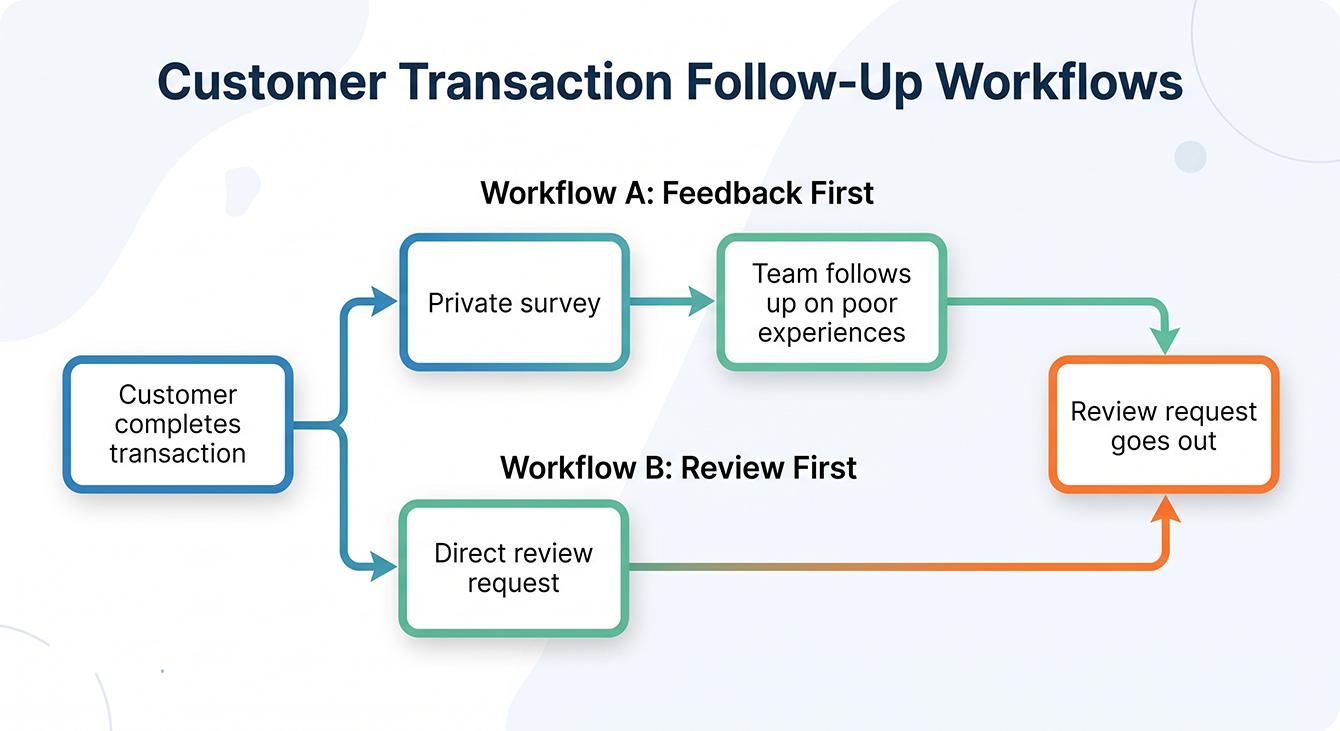
LoyaltyLoop is a fully managed reputation program rather than a tool you log into and run yourself. We handle setup, configuration, review generation, and ongoing management. You don't have to assign someone internally to keep it running, and you don't need to worry about whether that someone is keeping up with the job. We handle the entire review generation workflow: survey design, send timing based on your business rules, and review request routing. Survey feedback and new Google reviews flow into your dashboard, where your team monitors them and acts on them with your customers. Clients choose between two workflows: Feedback First, which collects private survey feedback before any review request goes out so your team can address concerns first, or sending review requests directly.
The main workflows are managed for you, and you can configure follow-up campaigns whenever you want to. Integrations connect through your own business systems' credentials, so keeping those connections current stays on your side, and we monitor most integrations to identify failures before you discover them as a silent gap in your data. ReviewMatch℠ matches your customer records to actual Google reviews, which solves the attribution problem that self-serve tools leave to your team. And the requests themselves are typically triggered post-transaction or post-experience, so real customers hear from you soon after their experience with your business. Many DIY tools simply let you upload a contact list and fire off review requests. A bulk send doesn't make the request timely, and it doesn't guarantee it's reaching a recent customer at all.
The fully managed reputation program is best for business owners who've never had time to run a reputation program. It's also for operators who tried a self-serve tool and abandoned it. Our clients average 8 to 10 years on the platform. That retention speaks for itself. Plans start at $99/month per location, plus a one-time setup fee. There's no long-term contract. Our clients simply decide to stay.
At the end of the day, the managed-vs-self-serve decision comes down to bandwidth. If you have internal capacity to configure and maintain a platform, self-serve tools like Birdeye and BrightLocal are strong options. If you don't, a fully managed reputation program like LoyaltyLoop removes that burden entirely.
Track Reviews and Attract More of Them
LoyaltyLoop gives your business a repeatable way to encourage more Google reviews. Learn how we request feedback, track review activity, and make replying to reviews easy as part of our fully managed service.
What Could Go Wrong After You Buy?
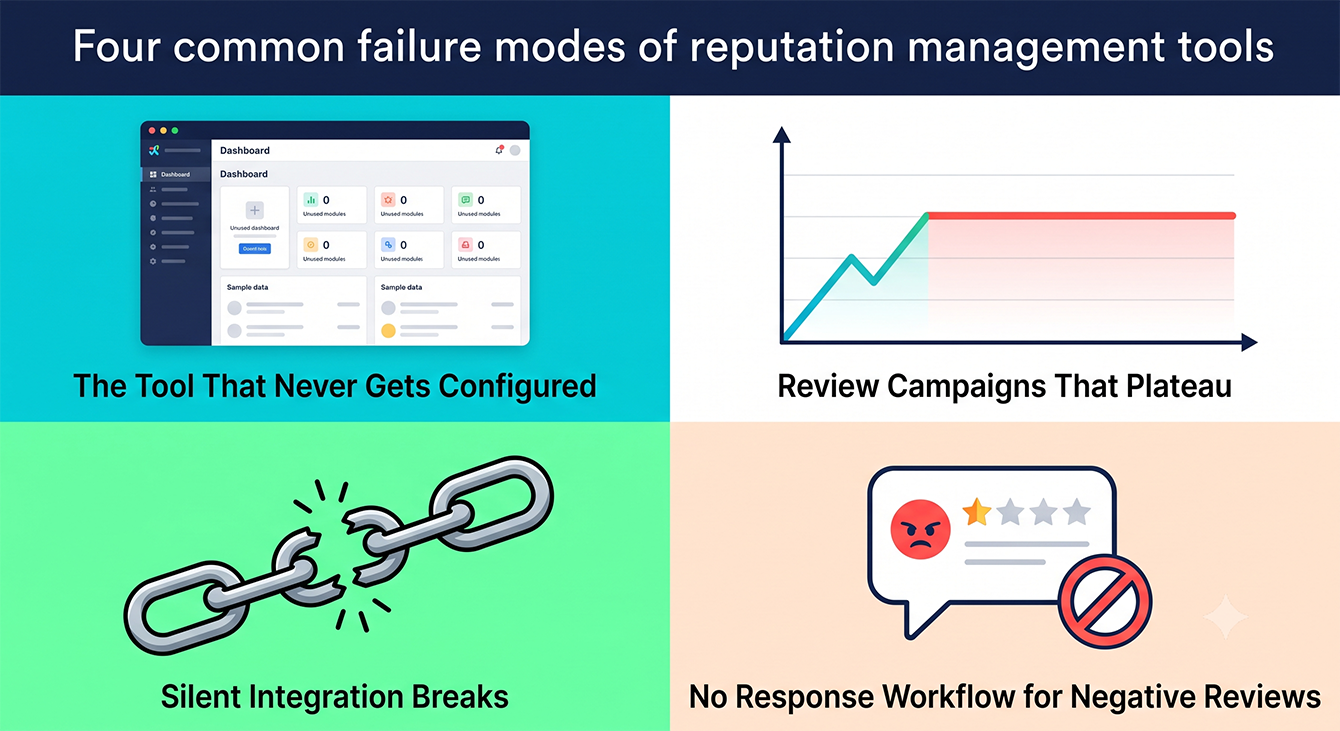
Reputation management software fails in four common ways: the tool never gets configured, review campaigns plateau, integrations break silently, and negative reviews go unanswered. Every one of these failures is preventable if you know what to watch for before you buy.
1. The Tool That Never Gets Configured
You sign the contract, finish setup, and the dashboard sits untouched. Nobody has time to kickstart campaigns, import contacts, or configure integrations. Weeks pass. The tool is technically "live" but producing nothing. You're not alone. Companies report using only 56% of purchased martech tools, according to The CMO Survey.
Ask the vendor what percentage of customers are actively using the platform 90 days after purchase. If they can't answer, that's your answer.
2. Review Campaigns That Plateau
Review requests go out for the first month. Volume spikes, then flattens because nobody adjusts timing, refreshes templates, or adds new customer segments. Review generation works; the prompting data earlier shows most consumers leave a review when asked. But only when the prompts keep going.
Ask whether the tool, or the team behind it, actively manages campaign optimization. Or is it a set-and-forget setup that depends on you to maintain momentum?
3. Silent Integration Breaks
The tool connects to your CRM or POS on day one. Three months later, an API update breaks the connection. Data stops flowing, and nobody notices until review volume drops to zero. A broken integration means your pipeline goes silent while competitors keep generating volume.
Ask whether the vendor monitors integrations ahead of time and alerts you when data flow stops. Or will you discover the break yourself weeks later?
4. No Response Workflow for Negative Reviews
A negative review lands on Google and sits unanswered for weeks. Nobody owns the response process. Consumers overwhelmingly favor businesses that reply to all reviews, as the BrightLocal data earlier shows. Silence is a conversion killer.
More importantly, review enforcement is scaling. Google blocked or removed over 292 million policy-violating reviews in 2025. The reviews that stay up carry more weight. Not responding to them is a bigger miss than ever. Ask whether the tool includes response templates, team routing, or escalation workflows. Better yet, ask whether it gives you AI-suggested reply drafts and a single place to respond, so answering never depends on someone remembering to log into Google.
Every failure mode on this list comes down to the same root cause: nobody was assigned to run the program after purchase. The operating model failed before the tool ever could.
Start Growing Your Google Reviews with LoyaltyLoop
You now know which tools monitor, which ones manage, and which model actually matches the bandwidth your team has. Features get you to a shortlist. The question that predicts success is whether someone will actually run the program after you buy it.
We built LoyaltyLoop as the fully managed alternative to self-serve tools. It's built for businesses that don't have someone internally to own the program daily. You get consistent review generation across every location without assigning anyone to run the system day to day. ReviewMatch ties your customer records to actual Google reviews so you know what's working. Let us do the heavy lifting for you.
Run a Review Program Without Owning It Daily
Owner-operators who've tried self-serve tools and watched them stall get consistent Google review generation without assigning anyone to run the system day to day.
FAQs about Reputation Management Tools
Q: What happens if nobody on my team has time to run the tool after we buy it?
A: Most self-serve reputation management software stalls when no one configures campaigns, monitors results, or responds to reviews. If you don't have a dedicated marketing manager or agency partner, a self-serve tool is a high-risk purchase. A fully managed program removes the burden entirely. Review requests keep going out whether or not anyone on your team logs in; your team still acts on the feedback that comes back.
Q: Can I use a reputation management tool if I have multiple locations?
A: Yes, look for location-level dashboards and central roll-up reporting. Reputation.com and LoyaltyLoop aggregate location-level data without pushing the burden down to each site.
Q: How much should I expect to pay for a reputation management tool?
A: Entry-level tools run roughly $31 to $99 per month for single-location businesses. Enterprise platforms require custom pricing and typically run into the hundreds per location per month. Birdeye, SOCi, and Podium don't publish pricing at all. If a vendor won't publish a number, factor that into your evaluation.
Q: How should teams use AI to respond to reviews safely?
A: AI drafting cuts response time, but keep a human between the draft and the post. Look for tools where AI suggests replies your team selects as a starting point, personalizes, and submits rather than posting automatically; LoyaltyLoop's AI Suggested Replies work this way, surfacing three draft options per review. Avoid any tool that auto-posts responses or claims to write and post reviews on a customer's behalf. No compliant platform posts reviews for customers.
Q: How long does it take to see results from a reputation management tool?
A: Expect the first measurable change, review velocity, within the first month if requests go out consistently. Average rating and local ranking movement take longer, typically three to six months, because Google weighs recency and steady review flow over one-time spikes. The variable that decides the timeline is consistency: programs that pause when the owner gets busy reset the clock. That's the argument for either assigning clear internal ownership or choosing a managed program that keeps requests flowing regardless of your team's bandwidth.