
Customer Satisfaction Survey Questions: 20 Examples + Template
Data is everywhere in the modern business landscape. Every interaction, transaction, click, and delivery leaves a digital footprint. Yet, for many small to mid-sized businesses, there remains a massive difference between collecting data and actually understanding the human beings behind those numbers.
You might know what your customers bought and when they bought it, but do you know how they actually felt about the experience? Would they recommend you to a colleague? Did your team make the process effortless, or did the customer have to jump through administrative hoops to get across the finish line?
To uncover these insights, you need to ask. But launching a feedback initiative without a clear framework is a recipe for disaster. If you ask the wrong questions, you get skewed data. If you ask too many questions, your abandonment rates skyrocket.
To build a high-performing feedback loop, you must utilize highly targeted, mathematically sound customer satisfaction survey questions. This comprehensive guide provides a reference-style bank of 20 battle-tested questions categorized by exactly what they measure, breaks down the core mechanics of survey design, and provides an adaptable template you can deploy immediately.
Main Takeaways
- The best questions are neutral and non-leading, so you get honest answers instead of the ones you're hoping for.
- Group your questions by what they measure: overall satisfaction, loyalty, effort, and the open-ended "why."
- Keep surveys short. The longer they run, the fewer people finish them.
- Pair rating questions with one open-ended box to capture the reasoning behind the score.
- A consistent, on-brand survey beats a generic form pieced together from a free tool.
The Mechanics of a High-Response Survey
Before copying specific CSAT question examples, it is vital to understand the psychological rules of survey design. A survey is not an interrogation; it is a brief conversational touchpoint. If it feels clinical, biased, or exhausting, your customers will simply close the window.
1. The Golden Rule: Writing Neutral, Non-Leading Language
The most common mistake small to mid-sized businesses make when learning how to write survey questions is leading the witness. A leading question guides the respondent toward a specific, positive answer, rendering the resulting data useless for real business growth.
- Leading Phrasing: "How incredible was your experience with our friendly support team today?" (This presumes the experience was incredible and the team was friendly).
- Neutral Phrasing: "How would you rate your experience with our customer support team today?" (This gives the customer total freedom to express their true sentiment).
Neutral language requires removing emotionally charged adjectives from the prompt itself. Let the rating scale handle the emotion, while the question remains a neutral platform.
2. The Completion Killer: Keeping It Short Enough to Finish
Survey fatigue is real. Every extra question you add to a form causes a measurable drop in completion rates. If a customer sees a progress bar that says "Page 1 of 5" or notices a scroll bar that keeps going, they will abandon the effort entirely.
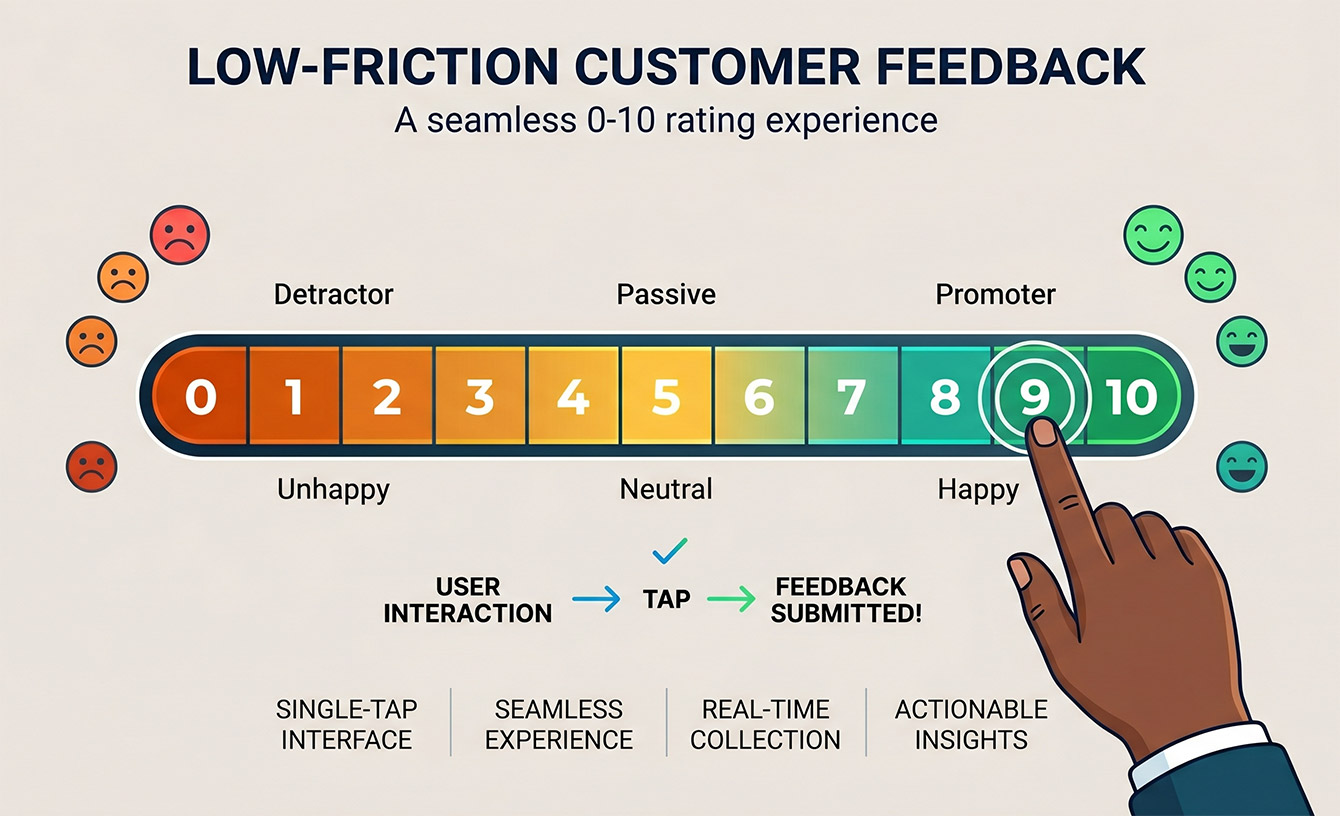
The sweet spot for a standard operational survey is under 2 minutes to complete. Ideally, this means structuring your outreach around 1 to 3 targeted quantitative questions, followed by a single qualitative open text field. By lowering the cognitive friction required to respond, you dramatically increase both your sample size and the accuracy of your baseline metrics.
The Ultimate Question Bank: 20 Customer Satisfaction Survey Questions
To build an actionable framework, your questions must be categorized by the specific operational or relational metric they are designed to measure. Here are 20 exceptional customer feedback questions organized into five distinct diagnostic categories.
Category A: Measuring Overall Satisfaction (CSAT)
Customer Satisfaction (CSAT) questions assess the user’s immediate happiness regarding a specific transaction, project, or interaction. They are highly transactional and provide a real-time pulse on your day-to-day operations.
Scale to Use: 1 to 5 (Not at all satisfied to Very satisfied) or 1 to 10.
- "How satisfied were you with the quality of the product/service you received today?"
- What it measures: Core product or output utility.
- When to use: Immediately following product delivery or project sign-off.
- "Overall, how would you rate your most recent experience with [Company Name]?"
- What it measures: Comprehensive brand touchpoint satisfaction.
- When to use: As a periodic relational health check.
- "How well did our team meet your expectations during our recent engagement?"
- What it measures: Alignment between sales promises and operational execution.
- When to use: At the conclusion of a service contract or major project milestone.
- "How satisfied are you with the speed at which your request was resolved?"
- What it measures: Operational efficiency and response times.
- When to use: Right after a customer support ticket or service call is closed.
Category B: Gauging Customer Loyalty & Advocacy (NPS®-Style)
Loyalty metrics look past the immediate transaction to evaluate the long-term health of the relationship. These questions help identify brand advocates who will fuel organic word-of-mouth growth.
Scale to Use: 0 to 10 (Not at all likely to Extremely likely).
- "How likely are you to recommend [Company Name] to a friend, colleague, or business partner?"
- What it measures: Relational loyalty and referral probability (The classic Net Promoter Score℠ question).
- When to use: Sent quarterly, bi-annually, or after key account reviews.
- "How likely are you to choose [Company Name] for your next [industry-specific service] project?"
- What it measures: Intention to repurchase or renew.
- When to use: 30 to 60 days before a contract renewal date or typical repurchase window.
- "How likely are you to expand your service or purchase additional products from us in the future?"
- What it measures: Upsell and cross-sell openness.
- When to use: Following a highly successful implementation or positive performance review.
- "If a business peer asked you about our industry, how likely would you be to proactively bring up [Company Name]?"
- What it measures: Passive vs. active brand advocacy.
- When to use: For strategic B2B accounts to measure deeply rooted goodwill.
Category C: Evaluating Customer Effort (CES)
Customer Effort Score (CES) questions are rooted in a powerful truth: customers value convenience. High friction breeds churn, even if your product is good. These questions find out how hard it is to do business with you.
Scale to Use: 1 to 7 (Do not agree at all to Strongly agree).
- "To what extent do you agree with the following statement: [Company Name] made it easy for me to handle my issue."
- What it measures: Process friction during problem resolution.
- When to use: Post-support or post-repair interactions.
- "How easy or difficult was it to navigate our onboarding/setup process?"
- What it measures: Early-stage customer experience and documentation clarity.
- When to use: 14 to 30 days into a new customer onboarding cycle.
- "How much effort did you personally have to exert to complete your purchase today?"
- What it measures: E-commerce checkout, billing, or sales transaction complexity.
- When to use: Immediately following invoice payment or digital checkout.
- "The documentation, instructions, or answers provided by our team were clear and straightforward to follow."
- What it measures: Communication clarity and technical accessibility.
- When to use: Following training sessions, delivery of manuals, or technical updates.
Category D: Unlocking the "Why" (Open-Ended Questions)
Quantitative scores tell you what is happening, but qualitative open-ended questions provide the context behind the numbers. They allow the true voice of the customer to shine through.
Scale to Use: Free-form open text box.
- "What is the primary reason for the score you gave us today?"
- What it measures: The core driver of customer sentiment.
- When to use: Positioned directly after any numerical rating question.
- "What could our team have done to make your experience even better?"
- What it measures: Actionable operational gaps and improvement opportunities.
- When to use: An excellent fallback question when a user provides an average or low rating.
- "Which specific aspect of our service stood out to you the most during this project?"
- What it measures: Key differentiators and internal team successes.
- When to use: Ideal for capturing positive highlights that can be used for team recognition.
- "Is there anything else you would like to share with our management team about your experience?"
- What it measures: Uncategorized feedback, hidden issues, or unique praise.
- When to use: Positioned at the absolute end of the survey as a catch-all.
Category E: Channel, Product, & Account Specifics
These questions hone in on distinct operational divisions within mid-sized businesses, allowing department heads to audit their specific workflows.
Scale to Use: 1 to 5 or 1 to 10.
- "How would you rate the professionalism and courtesy of the representative who assisted you?"
- What it measures: Staff conduct, soft skills, and brand alignment.
- When to use: Following direct field-service or customer-support interactions.
- "How well does our product/service integrate into your daily business operations?"
- What it measures: Long-term utility and workflow compatibility.
- When to use: Sent to B2B users during mid-year account check-ins.
- "How satisfied were you with the accuracy and condition of your shipment upon arrival?"
- What it measures: Supply chain, logistics, and fulfillment accuracy.
- When to use: Within 24 hours of package delivery confirmation.
- "How clearly did our sales representative explain our terms, pricing, and project timelines before you signed?"
- What it measures: Sales transparency and expectation setting.
- When to use: Shortly after contract signing or during the first project kickoff meeting.
The Plug-and-Play Customer Survey Template
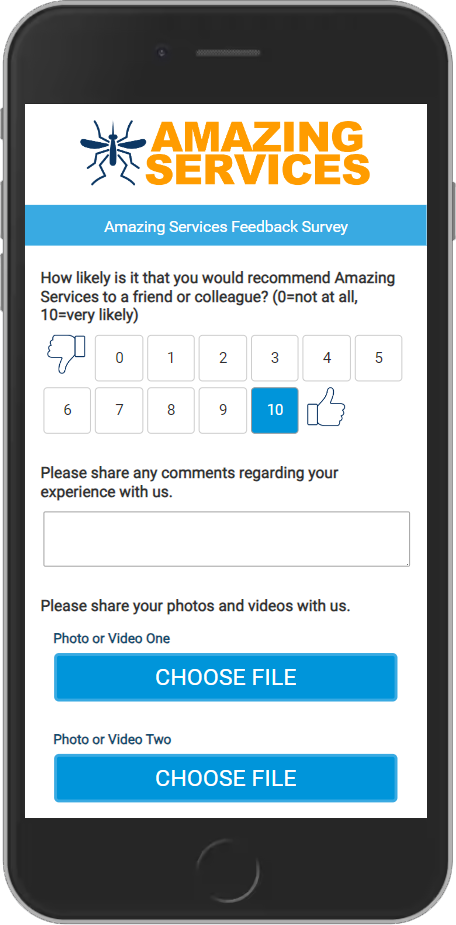
To combine these concepts into a high-converting baseline framework, you can use this simple, highly effective customer survey template. It balances quantitative tracking with an open-ended feedback box while remaining short enough to ensure excellent completion rates.
Why Managed Survey Programs Beat Manual Implementation
Copying these questions into a generic, free form builder is a decent starting point. However, small to mid-sized businesses quickly realize that building, launching, and maintaining an in-house survey infrastructure is a complex administrative and technical challenge.
When you attempt to manage this manually, you run into significant roadblocks:
- The Software Fragment: You have to purchase separate survey software, map api integrations to your CRM, and spend hours configuring automated triggers.
- The Branding Disconnect: Many DIY survey tools redirect your valuable customers to generic third-party domains with messy layouts that look disconnected from your corporate identity.
- The Static Data Trap: Collecting responses in a spreadsheet doesn't do any good if the data sits there unanalyzed. Without real-time alerting, negative experiences go unnoticed, and positive experiences aren't capitalized on.
The LoyaltyLoop Advantage: A Fully Managed Experience
You shouldn't have to become a survey software administrator just to find out what your customers think. This is why forward-thinking companies choose managed survey programs through LoyaltyLoop.
LoyaltyLoop doesn't just sell you a tool and leave you to assemble it yourself. We are the team that builds, designs, and completely maintains your custom, on-brand survey program from the ground up.
- Custom Built for Your Brand: Our team crafts custom surveys using the exact strategic question structures outlined above, framed perfectly inside your brand’s visual identity.
- Automated Flow, Zero Effort: We integrate directly into your operational workflow, ensuring surveys go out automatically at the exact moment of peak engagement via email or SMS.
- Actionable Real-Time Alerts: If a customer reports an issue, your leadership team receives an immediate notification, allowing you to intercept problems before they spiral.
- Seamless Review Promotion: When a customer gives a glowing rating, LoyaltyLoop automatically encourages online reviews so that positive sentiment is shared directly onto public platforms like Google, effortlessly multiplying your online review volume.
Stop building surveys by hand. Let LoyaltyLoop handle the architecture, the technology, and the maintenance, so you can focus entirely on acting on the insights.
Ready to ditch the DIY survey forms? Let our experts build a managed feedback program tailored exactly to your business goals. Click here to schedule your live, personalized demo with LoyaltyLoop today.
Schedule a DemoFrequently Asked Questions (FAQs)
Q: What scale is best for standard customer satisfaction questions?
A: For immediate satisfaction metrics (CSAT), a standard 1-to-5 Likert scale works best because it provides clear choices without overwhelming the user. For relationship-level loyalty and advocacy tracking, a 0-to-10 scale is universally preferred because it aligns precisely with standard Net Promoter Score methodologies.
Q: How many questions should a customer feedback survey contain?
A: To maximize completion rates and combat drop-offs, aim for 3 to 5 questions total. A high-converting survey structure typically features a primary satisfaction metric, a loyalty question, and a single open-ended comment box. Save longer, multi-question surveys for deep annual market research studies.
Q: How soon after an interaction should we send a customer survey?
A: For transactional or service-based businesses, timing is vital. You should trigger the survey within 24 hours of transaction completion while the details are entirely fresh in the customer's mind. For complex B2B service or product delivery, waiting 7 to 14 days allows the client enough time to fully evaluate the operational utility of your work. But don’t over-ask customers. Choose your timing carefully so you don’t annoy customers.
Q: What is a healthy response rate for an online customer satisfaction survey?
A: For external email surveys sent to B2B clients, we see a typical response rate range between 15% and 30%. For general consumers or B2C clients, we see response rates typically lower in the 10% to 20% range. If your response rates are not in these ranges, that is still ok. Every business is different. But if your response rates sustain below the typical low range, it could be an indicator that your survey is either too long, your subject line needs optimization, or your email timing is misaligned with the customer journey.