
What is Customer Effort Score (CES) and how does it compare to other CX metrics?

Photo by Andrea Piacquadio on Pexels
What is Customer Effort Score (CES)?
Customer Effort Score, or CES, measures the customer's level of effort (aka "work") to complete an interaction with your company. Interactions might include completing a purchase, getting a quote issued, getting help or answers to a question, completing a return/refund, and many other key interactions.
Why CES is important?
Customer Effort is a key measure of loyalty. In fact, it has been shown that as customer effort increases, so does the potential for customers to turn disloyal. Intuitively, that should make sense. If it is difficult for a customer to get something done with your business, the likelihood they look elsewhere for your products or services goes up.
"96% of customers with a high-effort service interaction become more disloyal compared to just 9% who have a low-effort experience"
Gartner, Inc.
Ensuring that you actively reduce friction in your business, thereby allowing customers to have easier interactions, will help you increase customer loyalty, reduce churn, and strengthen your brand.
According to Gartner's research, improving your CES can create the following benefits:
- Increased NPS
- Lower costs
- Higher repeat purchases
- Higher employee retention
How to measure CES?
Every business is different, and it is important to identify the key points of interaction between your business and your customers. Identify the journeys your customers follow through your business, from first contact to ongoing relations, and consider measuring CES at key interaction points.
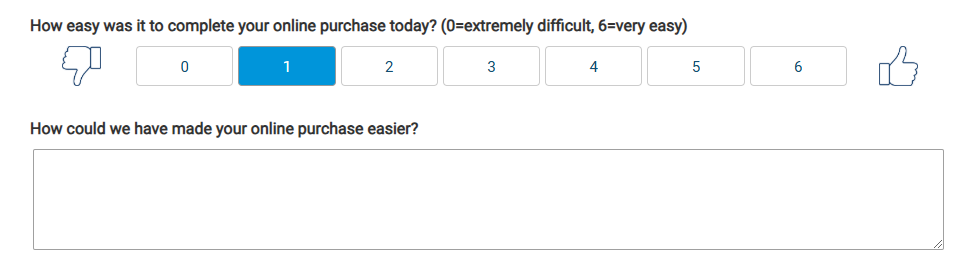
Typically, measured using a 5 or 7 point scale, CES asks a question about the specific interaction, such as "How easy was it for you to complete your online purchase? (0=extremely difficult, 6=very easy)". Paired with an open-ended question to qualify the respondents answer, more details can be captured regarding why the customer answered as they did. This insight can be valuable in building continuous improvement plans.
CES and NPS
Net Promoter ScoreSM, NPS® is the leading indicator of customer loyalty. Measured over time, it gives you great insight regarding how your customers feel about your business, when considering all of their integrations and experiences.
CES, on the other hand, measures a how the customer feels about a specific, but critical, business process or interaction. Each place where a customer can interact with your business is a potential point of friction and frustration for a customer. Regularly measuring CES over time can give you an early-warning system to identify specific areas that need improving. Pairing CES surveys with your NPS surveys gives you a more complete picture of your business.
Automating CES
Like any CX process, the more automated the better. Using triggers and automations to generate lists or flows of the customers exiting your key processes (e.g. purchase, ticket, quote, shipment) will allow you to more easily engage them for CES feedback. Using a CXM (Customer Experience Management) platform, like LoyaltyLoop, will ensure the right customers are engaged at the right time.
Calculating CES
Just like Customer Satisfaction (CSAT) and Product Quality (PQUAL), CES is measured on a scale of 0 to 100, and is calculated by dividing the number of respondents who found the interaction easy in any way (e.g. 4: "somewhat easy", 5: "easy", 6: "very easy") by the total number of respondents. If 70 out of 100 respondents found the process easy, you have a 70% CES for that process.
Start measuring, then build continuous improvement plans that reduces friction (i.e. effort) in the process. Set goals to increase your CES over time. Like all CX metrics, do not fixate on attaining a perfect score. Execute plans that allow you to improve CES, and maintain high levels.