
The 2026 Service Standard: Top Customer Service Benchmarks Every Business Should Know

Introduction: Why Benchmarking is the Compass of Growth
In 2026, "good" customer service is no longer a differentiator, it is the entry fee for staying in business. As AI integration becomes standard and consumer patience reaches an all-time low, businesses are finding that internal year-over-year improvements aren't enough to guarantee survival. To truly lead your industry, you must know how you stack up against the competition.
At LoyaltyLoop, we believe that benchmarking is the compass of sustainable growth. It moves your strategy from reactive "firefighting" to proactive experience management. By understanding where the global and industry-specific bars are set, you can identify precisely where your team is excelling and where a small adjustment could yield a massive return in customer retention. Benchmarking allows you to stop asking "How are we doing?" and start asking "How do we become the best in our market?"
The "Big Three" Experience Metrics
To understand your standing, you must first look at the "holy trinity" of experience metrics: NPS, CSAT, and CES. While tech giants often dominate these conversations, these metrics are arguably more critical for SMBs where every single customer relationship significantly impacts the bottom line.
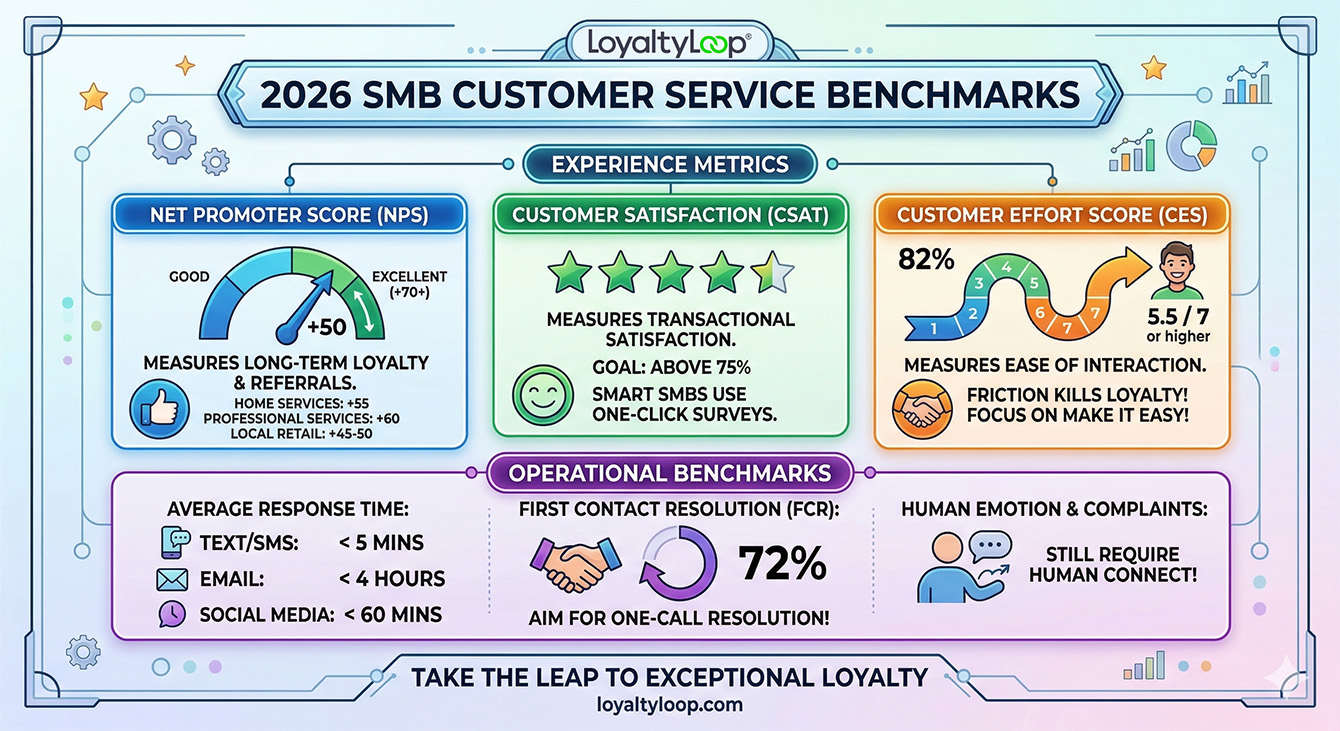
1. Net Promoter Score (NPS) Benchmarks NPS remains the gold standard for measuring long-term brand health and the likelihood of referrals. In 2026, the benchmarks for non-tech SMBs are surprisingly high because personal relationships still carry immense weight.
- Home Services (HVAC, Plumbing, Electrical): A "good" NPS in this sector is +55. Because these services are essential and invasive (entering a home), trust drives the score.
- Professional Services (Accounting, Law, Marketing Agencies): The benchmark here is +60. Clients expect high-touch communication and proactive advice.
- Local Retail & Specialty Shops: These businesses often see an NPS of +45 to +50. If your score is dipping below +30, it’s a clear signal that your "Passives" (the customers who are satisfied but not enthusiastic) are at high risk of jumping to a competitor for a lower price.
2. Customer Satisfaction Score (CSAT) CSAT measures the "here and now"—the immediate reaction to a specific interaction, like a completed repair or a recent purchase. The current global benchmark across SMB industries hovers around 82%. However, "survey fatigue" is a major threat in 2026. SMBs that succeed are moving away from 10-question surveys and toward "one-click" satisfaction checks sent via text or email immediately following a service call. If your CSAT is below 75%, it usually indicates a breakdown in the "last mile" of service delivery—perhaps a technician didn't clean up, or a follow-up call was missed.
3. Customer Effort Score (CES) This is the rising star of 2026 metrics. Modern customers—whether they are hiring a landscaper or buying office supplies—value ease over "wow" moments. A high CES (meaning the customer had to put in low effort) is a better predictor of repeat purchase behavior than high satisfaction.
- The Benchmark: On a 1–7 scale, you should aim for a 5.5 or higher.
- The SMB Reality: If a customer has to call your office three times just to get a quote, your effort score is failing. High-performing SMBs use automation to make scheduling, invoicing, and feedback seamless.
Operational Excellence: Speed and Resolution Benchmarks
Operational benchmarks tell you if your "engine" is running efficiently. In 2026, the gap between "slow" and "fast" businesses has become a chasm.
- First Contact Resolution (FCR): The industry standard is currently 72%. For an SMB, this means the customer's question was answered or their problem was scheduled for repair during the very first phone call or email. If your FCR is low, your "hidden" costs are rising because your staff is spending time handling the same issues repeatedly.
- Average Response Time: * Text/SMS: The benchmark is now under 5 minutes.
- Email: The "acceptable" window for a local business has shrunk to 4 hours.
- Social Media: If a customer tags your business on a local forum or Facebook, they expect a response within 60 minutes.
- Human-to-Human Benchmarks: While AI handles routine questions, the benchmark for "High-Empathy" interactions—handling a complaint or a complex project—remains human-centric. In 2026, customers still prefer a 5-minute conversation with a knowledgeable local expert over a 15-minute loop with an unhelpful bot.
From Data to Strategy: How to Use These Benchmarks
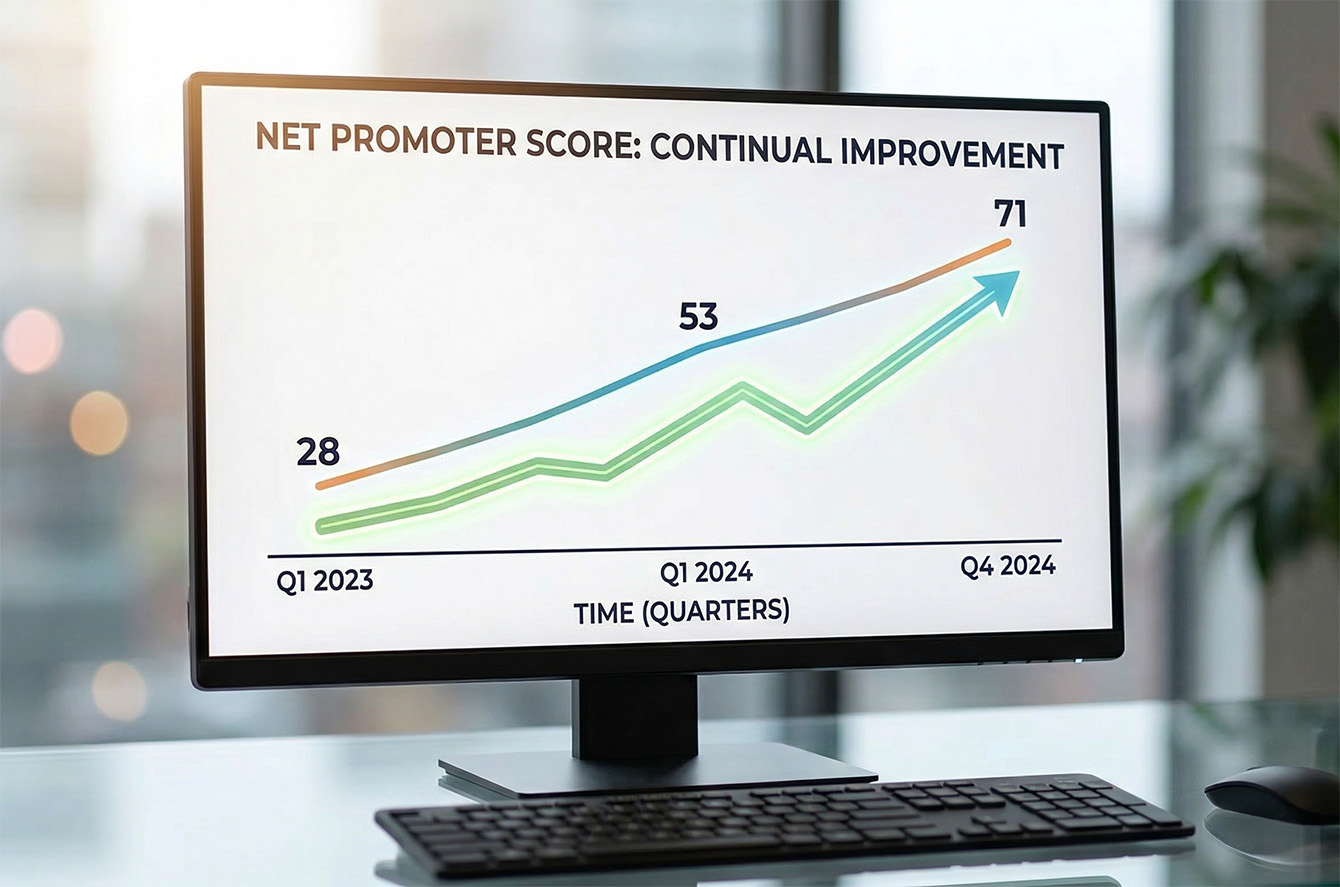
Raw data is just noise unless you have a strategy to act on it. Don't fall into the "Comparison Trap" of only looking at others. While knowing the industry average is vital for setting goals, your most important benchmark is your own historical trend line.
- Identify the Gaps: If the industry NPS is +55 and you are at +40, look at your "Detractors." What is the common thread?
- Empower Your Team: Share these benchmarks with your staff. When a service technician knows that the goal is an 85% CSAT, they have a tangible standard to uphold.
- Close the Loop: This is the most critical step. When a benchmark reveals a "below-average" score, don't just record it—react to it. Reaching out to an unhappy customer within 24 hours can turn a negative experience into a story of "heroic" service that the customer then shares with their friends.
Conclusion: Your Roadmap to Exceptional Loyalty
Benchmarking isn't about being perfect; it's about being better than you were yesterday and staying ahead of the curve. By tracking these 2026 standards, you give your team a clear goal and your customers a reason to stay. In a world where consumers have endless choices, the businesses that measure their success through the eyes of their customers are the ones that will thrive.
Ready to see where you stand? At LoyaltyLoop, we automate the feedback process, giving you real-time benchmarks and the actionable insights you need to outperform your industry. Schedule a Demo today and start turning your feedback into a competitive advantage.
Schedule a DemoFrequently Asked Questions (FAQs)
Q: How do I find benchmarks for my specific local industry?
A: LoyaltyLoop provides industry-specific data, but you can also look at trade association reports for your specific niche (e.g., HVAC or Legal associations).
Q: Is a low NPS always bad?
A: Not necessarily,it’s a starting point. A low score is an opportunity to identify systemic issues in your business before they lead to lost revenue.
Q: Why should an SMB care about "Customer Effort"?
A: Because friction kills loyalty. If you are harder to work with than the "big box" store down the street, customers will choose convenience over "local" every time.
Q: Can I automate benchmarking?
A: Yes. Tools like LoyaltyLoop automatically calculate your NPS and CSAT and compare them against your historical averages so you can see progress at a glance.