Tip

December 2025

The Feedback-Driven Revenue Engine: Boosting Sales Through CX & Feedback

A LoyaltyLoop Guide

loyaltyloop boosting sales through cx & feedback

Photo by Ahmed Zayan on Unsplash

1. Executive Summary: The ROI of Experience

In today's hyper-competitive digital landscape, your product or service is no longer your primary differentiator. Your competitors can copy your features and underbid your price. What they cannot easily replicate is the experience you provide. Customer Experience (CX) has evolved from a "soft" business concept into a critical driver of hard financial results.

For many organizations, a disconnect exists between the Customer Support department collecting feedback and the Sales department chasing new leads. This guide bridges that gap. It demonstrates that a robust Customer Experience (CX) Strategy, fueled by a continuous Customer Feedback Loop, is one of the most potent sales tools available.

By systematically listening to your customers, acting on their insights, and leveraging their positive sentiment, you transform feedback from mere data into a renewable source of revenue. We will explore how shifting focus from pure acquisition to retention enhances profitability, how metrics like Net Promoter Score (NPS) predict future growth, and how Social Proof Marketing can turbocharge your sales efforts.

This guide is designed for forward-thinking leaders ready to unlock the hidden revenue potential within their existing customer base.

2. The New Sales Funnel: Why CX Strategy is the New Marketing

The traditional sales funnel is dead. The old model—prospect, qualify, close, and move on—ignores the reality of the modern buyer's journey. Today's customers trust peers more than salespeople. They research extensively, read reviews, and rely on social proof before ever engaging with your team.

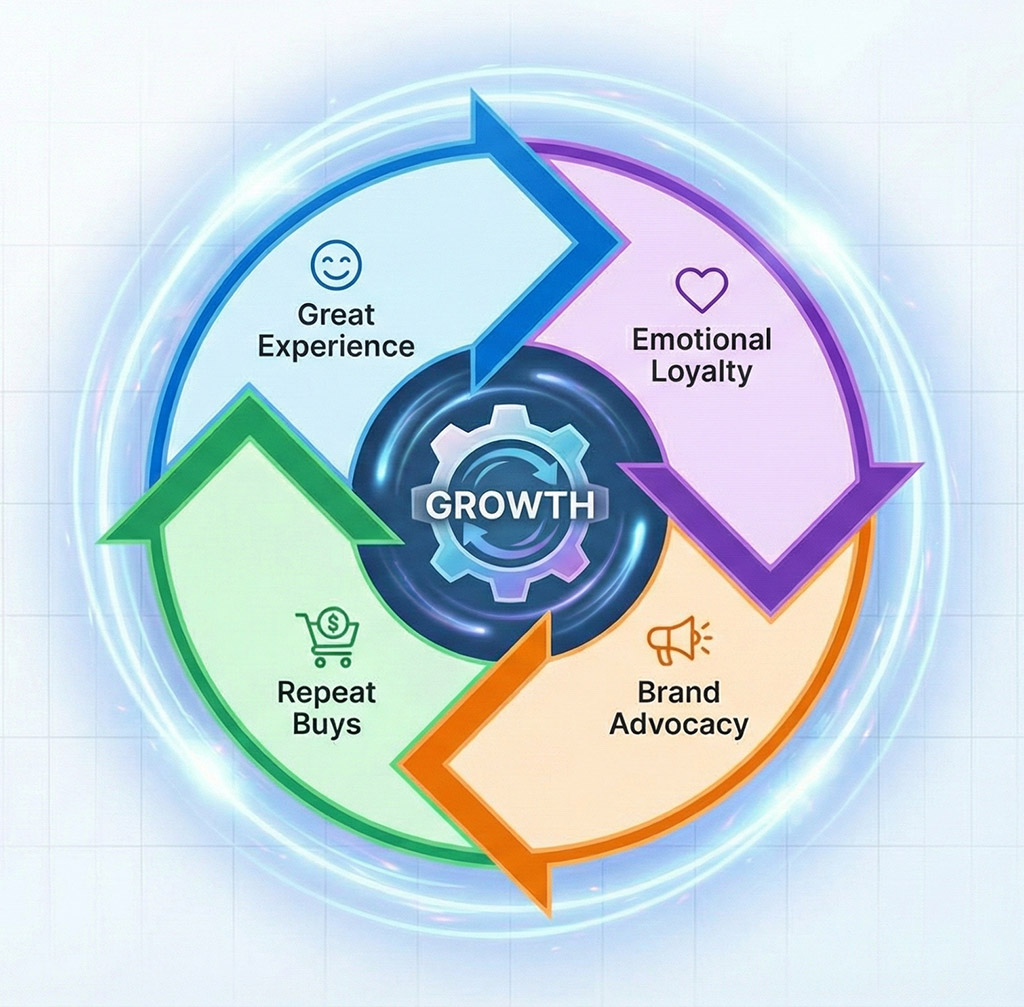
In this new reality, your best marketing asset is a satisfied customer. Their experience doesn't end at the point of sale; it begins there. A modern Customer Experience (CX) Strategy recognizes that the post-purchase experience directly feeds the top of the funnel for future customers.

The Loyalty Loop

The Customer Decision Journey

When you deliver an exceptional experience, you create advocates who do your marketing for you. Conversely, a poor experience creates detractors who can sabotage future sales efforts through negative word-of-mouth. Therefore, investing in CX is not merely an operational cost; it is a strategic marketing investment with a direct, measurable impact on sales velocity and conversion rates.

3. The Economics of Loyalty: Retention vs. Acquisition Costs

Every business leader knows the adage: "It costs more to acquire a new customer than to keep an existing one." Yet, sales teams are often incentivized almost exclusively on bringing in new customers. This misalignment leaves massive profitability on the table.

Understanding the economics of Customer Retention vs. Acquisition is fundamental to a feedback-driven sales strategy. While acquisition is necessary for growth, retention is essential for profitability. Studies consistently show that acquiring a new customer can cost anywhere from five to twenty-five times more than retaining an existing one.¹

The "Leaky Bucket" Analogy

Imagine your business as a bucket. Sales pours new customers into the top (Acquisition).

But if there are holes in the bottom (poor CX leading to churn), you will never fill the bucket, no matter how hard the sales team works.

A great CX strategy plugs the holes.

Furthermore, existing customers are far more likely to buy from you again. They know your processes, trust your brand, and require less hand-holding. Increasing customer retention rates by just 5% can increase profits by 25% to 95%.²

By using feedback to identify friction points and resolve them before a customer churns, you are directly protecting revenue. Every customer saved is a sale you don't have to replace at a high acquisition cost. A strong feedback program acts as an early warning system for churn, allowing your team to intervene and secure that recurring revenue.

4. Measuring What Matters: Understanding NPS and Satisfaction Metrics

You cannot manage what you do not measure. To turn experience into revenue, you need reliable metrics that track sentiment over time. While there are many alphabet-soup acronyms in the CX world, a few key metrics are essential for linking feedback to sales performance.

Net Promoter Score (NPS)

NPS is the gold standard for measuring customer loyalty. It is based on a single, powerful question: "On a scale of 0 to 10, how likely are you to recommend our company/product/service to a friend or colleague?"

  • Promoters (Score 9-10): Your loyal enthusiasts. They buy more, stay longer, and refer others. They are your secret sales force.
  • Passives (Score 7-8): Satisfied but unenthusiastic customers. They are vulnerable to competitive offerings.
  • Detractors (Score 0-6): Unhappy customers who can damage your brand and impede growth through negative word-of-mouth.

Your NPS is calculated by subtracting the percentage of Detractors from the percentage of Promoters. A high NPS correlates strongly with organic growth. Tracking NPS allows you to predict future sales trends based on current customer sentiment.

Customer Satisfaction Score (CSAT)

While NPS measures long-term loyalty, CSAT measures satisfaction with a specific interaction, product, or service. It's typically a "How satisfied were you with..." question rated on a scale. CSAT is crucial for identifying immediate operational issues that could derail a sale or lead to churn down the line.

5. Listening at Scale: Implementing a Voice of the Customer (VoC) Program

Sending out an occasional survey is not a strategy. To truly harness the power of feedback, organizations need a structured Voice of the Customer (VoC) program. A VoC program is a systematic approach to capturing, analyzing, and acting on customer feedback across all touchpoints.

Moving beyond passive listening involves proactively seeking feedback at critical moments in the customer journey:

  • Post-Purchase: immediately after a sale to gauge initial impressions.
  • Post-Support Interaction: to measure the effectiveness of your service team.
  • Periodic Relationship Surveys: to track long-term sentiment (NPS).
  • Exit Surveys: to understand why customers churn.

A successful VoC program doesn't just collect data; it democratizes it. The insights gathered shouldn't die in a spreadsheet in the marketing department. They must be shared with sales, product teams, and leadership to drive strategic decision-making.

6. The Feedback Ecosystem: Designing an Effective Customer Feedback Loop

The most critical failure point in any feedback strategy is the lack of a "closed loop." Gathering feedback without acting on it is worse than not asking at all—it sets an expectation of listening that you fail to meet, leading to customer cynicism.

An effective Customer Feedback Loop consists of three essential steps:

  1. Ask (Collect): Use automated tools to gather feedback at the right time through the right channel (email, SMS, web).
  2. Analyze (Understand): Don't just look at the score. Read the verbatim comments. Use text analytics to identify common themes, sentiment, and root causes of both satisfaction and dissatisfaction.
  3. Act (Improve & Respond): This is where the magic happens. "Acting" has two levels:
    • Systemic Action: Using aggregated data to fix broken processes, improve products, or retrain staff.
    • Individual Action (Closing the Loop): Reaching out personally to a customer who provided feedback—especially negative feedback—to resolve their issue.
feedback loop

Graphic by Google Gemini

7. From Data to Action: Closing the Loop to Save At-Risk Revenue

The immediate sales application of feedback lies in saving at-risk revenue. When a customer identifies as a "Detractor" (an NPS score of 0-6) or provides negative comments, they are waving a red flag that says, "I am about to leave and take my money to your competitor."

An automated feedback system should immediately flag these responses and route them to the appropriate person—a customer success manager, a support lead, or even a sales rep.

The Service Recovery Paradox

Quickly closing the loop with a dissatisfied customer is a powerful sales tactic. Research on the "Service Recovery Paradox" shows that a customer who experiences a problem that is quickly and effectively resolved often becomes more loyal than a customer who never experienced a problem at all.

By reaching out, listening to their grievance, and genuinely solving their problem, you demonstrate a commitment that builds immense trust. You convert a potential source of negative reviews into a loyal advocate who has experienced your dedication first-hand. This is revenue rescue in its purest form.

8. Turning Happy Customers into Advocates: The Power of Social Proof Marketing

On the flip side of saving detractors is leveraging promoters. Your promoters (NPS 9-10) are delighted with your service. They are ripe for upselling, cross-selling, and, most importantly, advocacy.

Social Proof Marketing is the psychological phenomenon where people copy the actions of others in an attempt to undertake behavior in a given situation. In sales, this means prospects are far more likely to trust the word of your happy customers than your slickest sales pitch.

Your feedback system should automatically identify these promoters and prompt them to take the next step:

  • Request a Testimonial: Ask for permission to use their positive verbatim comments on your website or in sales decks.
  • Ask for a Referral: Happy customers are often willing to refer peers but need to be prompted.
  • Invite to a Case Study: Engage them for a more in-depth success story that your sales team can use to overcome objections with similar prospects.
  • Encourage a Review: Encourage customers to share reviews on Google and other public sites to advocate for your business.

Systematically harvesting this positive sentiment turns a "feel-good" metric into collateral that directly closes new deals.

9. The Direct Link: Analyzing the Impact of Reviews on Sales Conversion

In the digital age, online reviews are your 24/7 sales force. They are often the first thing a prospect sees when researching your company. The Impact of Reviews on Sales is undeniable:

  • Nearly 95% of shoppers read online reviews before making a purchase.³
  • Displaying reviews can increase conversion rates by upwards of 270%.

Managing Negative Reviews

You will get negative public reviews. Do not ignore them.

A professional, empathetic public response demonstrates to prospects that you care about customer satisfaction and handle issues proactively.

This can sometimes be even more powerful than a positive review.

A feedback strategy that doesn't include a mechanism for generating public reviews is incomplete. When you identify a promoter through your internal feedback loop, you must have an automated workflow that encourages them to share that feedback publicly on platforms like Google, G2, Capterra, or industry-specific review sites.

A steady stream of fresh, positive, 4- and 5-star reviews builds instant credibility with cold prospects, shortens sales cycles, and dramatically improves the conversion rate of your marketing traffic.

10. Maximizing Profitability: Increasing Customer Lifetime Value (CLV) through Engagement

Ultimately, the goal of linking CX and sales is to maximize Customer Lifetime Value (CLV). CLV is the total predicted revenue a customer will generate throughout their entire relationship with your company.

Engaged customers who feel heard and valued stay longer and spend more. Regular feedback touchpoints keep the lines of communication open outside of a transactional sales call. They provide opportunities to:

  • Identify Upsell Needs: A customer commenting on a desire for a specific feature might be a perfect lead for a higher-tier plan.
  • Reinforce Value: The act of asking for feedback reminds the customer that you care about their success, reinforcing the value of their investment.

By focusing on increasing CLV through superior experience, you shift the business model from a constant, expensive hunt for new leads to a stable, profitable foundation of recurring revenue and expansion from within.

11. Automating the Process: Technology as an Enabler

Implementing a high-touch feedback strategy at scale is impossible manually. You cannot rely on individual sales reps or support agents to remember to send surveys, analyze results, and close the loop consistently.

Technology is the essential enabler. A modern Customer Experience Management (CXM) platform automates the entire Customer Feedback Loop:

  • Trigger-based sending: Automatically sending surveys based on specific events (e.g., ticket closure, contract renewal).
  • Real-time alerts: Notifying the right team member instantly when negative feedback arrives.
  • Workflow integration: Integrating feedback data directly into your CRM (like Salesforce or HubSpot), so sales reps have a complete view of customer sentiment before they pick up the phone.
  • Review generation: Automatically routing happy customers to public review sites.

Automation ensures consistency, frees up your team to focus on high-value interactions, and ensures no critical feedback falls through the cracks.

12. Overcoming Common Pitfalls: Why Feedback Strategies Fail

While the benefits are clear, many companies struggle to implement effective feedback strategies. Here are common pitfalls to avoid:

  • Survey Fatigue: Bombarding customers with too many long, complex surveys. Keep it short, relevant, and infrequent enough to be respectful of their time.
  • Data Silos: Hoarding feedback data in one department. Sales needs support data, product needs sales data. The insights must flow freely.
  • Lack of Follow-up: The cardinal sin. Asking for feedback and ignoring it destroys trust. Always close the loop, especially with detractors.
  • Focusing on the Score, Not the "Why": Obsessing over moving the NPS number by a point without understanding the underlying drivers of sentiment. The value is in the verbatim comments, not just the score.

13. Case Studies in Success: Brands that Won by Listening

B2B Software Company Reduces Churn by 15%

A mid-sized B2B SaaS company faced high churn at renewal time. They implemented a transactional CSAT survey after every support ticket and a relational NPS survey 90 days before renewal. By configuring immediate alerts for low scores, their Customer Success team reached out to at-risk accounts proactively. They discovered a recurring issue with a specific integration. By fixing the product issue and personally managing the affected accounts, they reduced annual churn by 15%, saving hundreds of thousands dollars in recurring revenue.

Service Provider Bootstraps Sales with Reviews

A regional home services company struggled to compete with national chains. They started using an automated system to text customers a feedback request immediately after a service call. Promoters were automatically prompted to leave a Google review with one click. Within six months, they went from 20 reviews to over 350, with a 4.9-star average. Their organic search ranking skyrocketed, and inbound leads from Google tripled, directly attributable to their enhanced social proof.

14. Building a Customer-Centric Culture: Beyond the Sales Team

Linking CX to sales isn't just a tactic; it's a cultural shift. It requires breaking down silos and uniting the entire organization around the customer.

  • Share the Data: Make feedback streams visible to everyone. Display real-time NPS comments on monitors in the office or in a dedicated Slack channel.
  • Incentivize Behavior: Consider tying a portion of sales and support compensation to CX metrics like NPS or retention rates. This aligns everyone's wallet with the customer's success.
  • Celebrate Wins: Publicly recognize employees who receive glowing feedback. Share stories of successful "closed-loop" recoveries.

When every employee—from accounting to the warehouse to the C-suite—understands that their job ultimately impacts the customer experience and, therefore, the company's revenue, you have built a truly customer-centric culture.

15. Conclusion & Action Plan: Your Roadmap to Revenue Growth

The path to sustainable sales growth is no longer just about louder marketing or aggressive sales tactics. It’s about delivering an experience that creates loyalty and harnessing the voice of your customers to prove your value to the market.

Your customers are speaking. They are telling you how to improve your product, how to beat your competition, and who is ready to buy more. The only question is: Are you listening, and do you have the systems in place to turn that listening into revenue?

Your Action Plan to Get Started:

  1. Audit Your Current State: How are you collecting feedback today? Is it ad-hoc or systematic? Who sees the data?
  2. Define Your Metrics: Decide on 1-2 key metrics to track (e.g., NPS and transactional CSAT).
  3. Map the Journey: Identify the key touchpoints where feedback is most critical.
  4. Implement a Tool: Choose a technology partner that can automate the collection, analysis, and closed-loop process.
  5. Define Workflows: Establish clear internal processes for who handles detractor alerts and who manages promoter requests for reviews.
  6. Start Small, Then Scale: Begin with one touchpoint (e.g., post-support), refine your process, and then expand to relationship surveys and other areas.

Start listening today, and watch your sales grow tomorrow.

Footnotes:

¹ Harvard Business Review, "The Value of Keeping the Right Customers"

² Bain & Company, "Prescription for Cutting Costs"

³ Spiegel Research Center, "How Online Reviews Influence Sales"

⁴ Spiegel Research Center, "How Online Reviews Influence Sales"