
What is the Difference Between Customer Service and Customer Experience?
In the business world, we love our acronyms. But few are as frequently confused, and interchangeably used, as "CS" (Customer Service) and "CX" (Customer Experience).
If you ask ten business owners to define the difference, you will likely get ten different answers. Many assume they are the same thing. After all, both involve taking care of the customer, right?
While they are certainly related, treating them as synonyms is a strategic mistake.
Think of it this way: Customer Service is like a doctor treating a specific ailment. You go in with a broken arm, they fix it, and you leave. It is vital, necessary work. Customer Experience is the entire healthcare system. It is how easy it was to book the appointment, how clean the waiting room was, how friendly the receptionist was, how clear the billing process was, and how well the doctor fixed your arm.
To truly grow your business, you need to understand the difference between CX and Customer Service. You cannot rely on a great support team to fix a broken brand experience. Let’s break down why.
The Fundamental Shift: Reactive vs. Proactive
The most significant distinction lies in the direction of the interaction.
Customer Service is almost exclusively reactive. It is event-based. It happens when a customer initiates contact because they have a need, a question, or a problem.
- A customer calls because their internet is down.
- A diner complains that their soup is cold.
- A client emails asking for a copy of an invoice.
In these scenarios, the business is reacting to a trigger. Success is measured by how quickly and effectively you resolve the issue.
Customer Experience (CX), on the other hand, is proactive and holistic. It encompasses every interaction a customer has with your brand, often before they ever speak to a human. It anticipates needs rather than waiting for problems.
When we look at Reactive vs Proactive Customer Support, we see that CX tries to ensure the problem never happens in the first place.
- Service: Helping a customer reset their password over the phone.
- Experience: Designing a website where the "Forgot Password" flow is so intuitive the customer never needs to call.
The Scope: Single Events vs. The Entire Journey
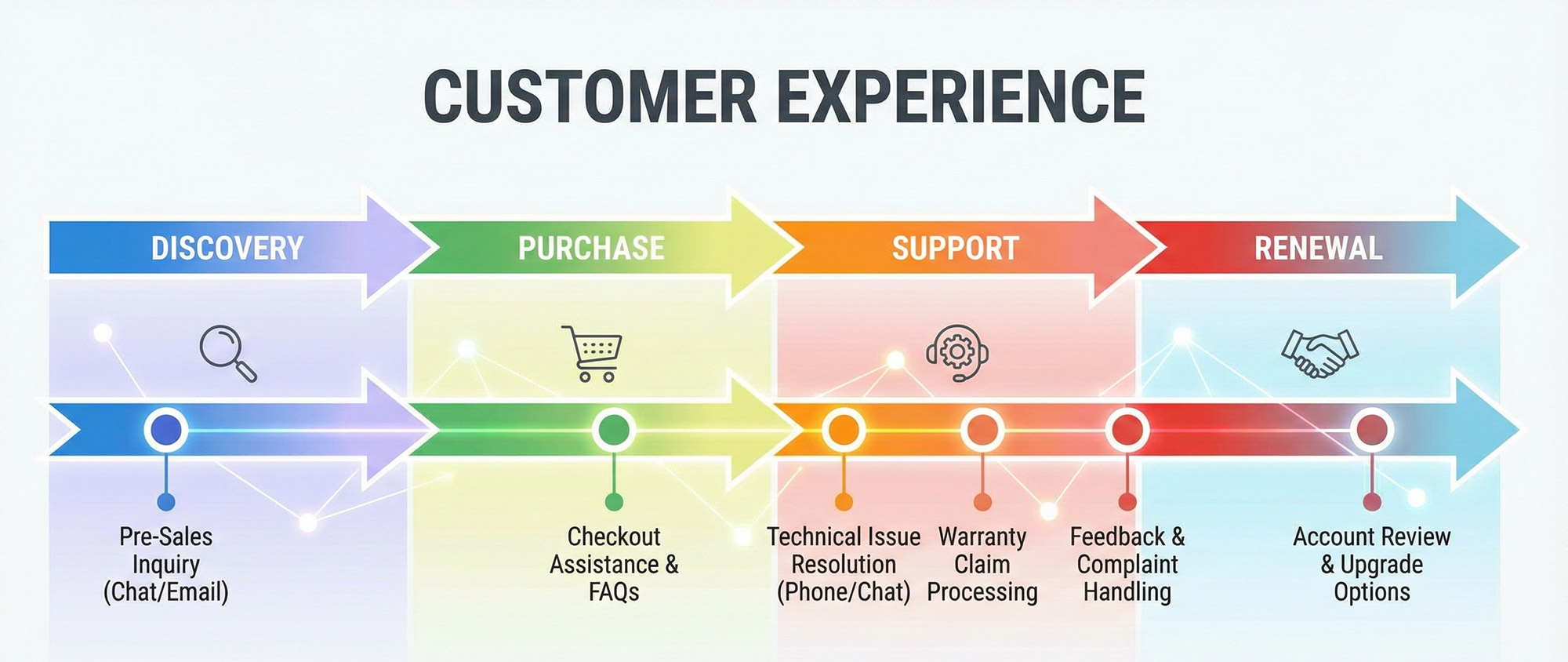
Another way to visualize this is by looking at the timeline. Customer Service is a specific point in time; Customer Experience is the timeline itself.
Customer Service is a Department. It is a specific team with specific skills (empathy, troubleshooting, patience).
Customer Experience is a Culture. It belongs to everyone, from the marketing team writing the ads, to the product team designing the packaging, to the finance team sending the bills.

This is where Customer Touchpoints come into play. A touchpoint is any way a consumer creates an opinion about your brand, and may be an interaction you should measure.
- Visiting your website.
- Reading a Google Review.
- Unboxing your product.
- Receiving an invoice.
- Calling your help desk.
Notice that "Calling your help desk" is just one item on that list. If you have the friendliest support team in the world, but your website is slow, your billing is confusing, and your product breaks constantly, your Customer Experience is poor, even if your Customer Service is excellent.
When analyzing the Customer Journey vs Customer Service, remember that the journey begins the moment they discover you and continues long after the sale. A narrow focus on service ignores the vast majority of the customer’s life with your brand.
The Bottom Line: Why CX Drives Growth
Why does this semantic difference matter to your bottom line? Because "satisfaction" is no longer enough to guarantee loyalty.
Customer Service is a defensive strategy. Its primary goal is to prevent loss. When a customer has a problem, they are unhappy. Good service brings them back to neutral or satisfied. It stops the bleeding.
Customer Experience is an offensive strategy. Its goal is the Role of Customer Experience in Business Growth. A phenomenal experience - one that is seamless, personalized, and proactive - does more than just retain customers; it creates "Promoters."
Promoters are customers who are so delighted by the ease of doing business with you that they:
- Buy more (Increase Lifetime Value).
- Stay longer (Reduce Churn).
- Refer others (Lower Acquisition Costs).
If you only focus on service, you are merely putting out fires. When you focus on experience, you are building a fireproof house that people want to visit.
Conclusion
Turn Your Customer Experience into Your Competitive Advantage
Understanding the distinction between customer service and customer experience is only the beginning. As we have seen, relying solely on defensive service strategies means you are merely putting out fires, rather than building a fireproof house that customers love to visit. To truly grow, you must shift your focus from simply resolving tickets to measuring the entire journey.
This is where LoyaltyLoop comes in. We help you move beyond reactive support by automating the feedback process, allowing you to capture the "full picture" of your customer's life with your brand. By tracking metrics like Net Promoter Score (NPS), LoyaltyLoop empowers you to identify and nurture the "Promoters" who will buy more, stay longer, and refer others.
Don't leave your customer experience to chance. Schedule a demo of LoyaltyLoop today and discover how to turn every touchpoint into an opportunity for growth.
Frequently Asked Questions (FAQs)
Q: What is the main difference between Customer Service and Customer Experience?
A: The primary difference lies in the scope and direction of the interaction. Customer Service is reactive and event-based, usually happening when a customer initiates contact regarding a specific problem5. Customer Experience (CX) is proactive and holistic, covering the entire timeline of interactions a customer has with your brand, often anticipating needs before they arise.
Q: Why is Customer Experience considered an "offensive" strategy for growth?
A: While Customer Service acts as a defensive strategy to prevent loss and fix immediate issues, Customer Experience is an offensive strategy designed to drive business growth. A phenomenal experience creates "Promoters" - customers who increase their lifetime value, reduce churn, and lower your acquisition costs by referring others.
Q: Does Customer Experience only involve my customer support team?
A: No. While Customer Service is a specific department requiring skills like empathy and troubleshooting, Customer Experience is a culture that involves the entire company. From the marketing team writing ads to the finance team sending invoices, everyone contributes to the various touchpoints that form the customer's opinion.
How should I measure the success of my Customer Experience versus my Service?
A: Service is typically measured by efficiency metrics, such as how quickly you resolve a ticket or issue. Customer Experience, however, requires looking at the journey through the customer's eyes using broader metrics like Net Promoter Score (NPS) to gauge overall loyalty and sentiment.