
Feedback Management: Process, Metrics, and Who Runs It
You've set up feedback surveys and watched them quietly stop running. Often, no one internally had the bandwidth to own it past setup.
Customer feedback management is the operational program that collects, analyzes, and acts on customer feedback. It then closes the loop with the customer who gave it. Most programs stall for one reason: no one runs them after launch.
Feedback management only works when someone owns collection, analysis, action, and follow-through at every stage. Businesses that treat it as ongoing operational work retain more customers. They also catch problems before they go public.
Main Takeaways
- Customer feedback management is the operational program that collects, analyzes, and acts on customer feedback, and then closes the loop with the customer who gave it. It runs in four stages, and skipping any of them causes stalls.
- Collection should pull from at least two streams: solicited feedback (triggered surveys) and unsolicited feedback (reviews, tickets, and social mentions).
- Closing the loop is the stage most programs skip. Follow up with every customer who gave feedback within 24 hours for negative responses, even when you can't change what they raised.
- Measure the program with five key KPIs: loyalty, satisfaction, effort, response rate, and churn. Review them daily or as close to it as your volume allows.
- The most common failure mode is ownership. Programs die when no one has bandwidth to run them. Assign an internal owner or hand the work to a managed program.
See Where Feedback Fits in the Bigger Picture
Feedback management is one piece of the full customer experience. This guide explains customer experience management (CXM) and how the pieces connect.
How Customer Feedback Management Works: The Four-Stage Process
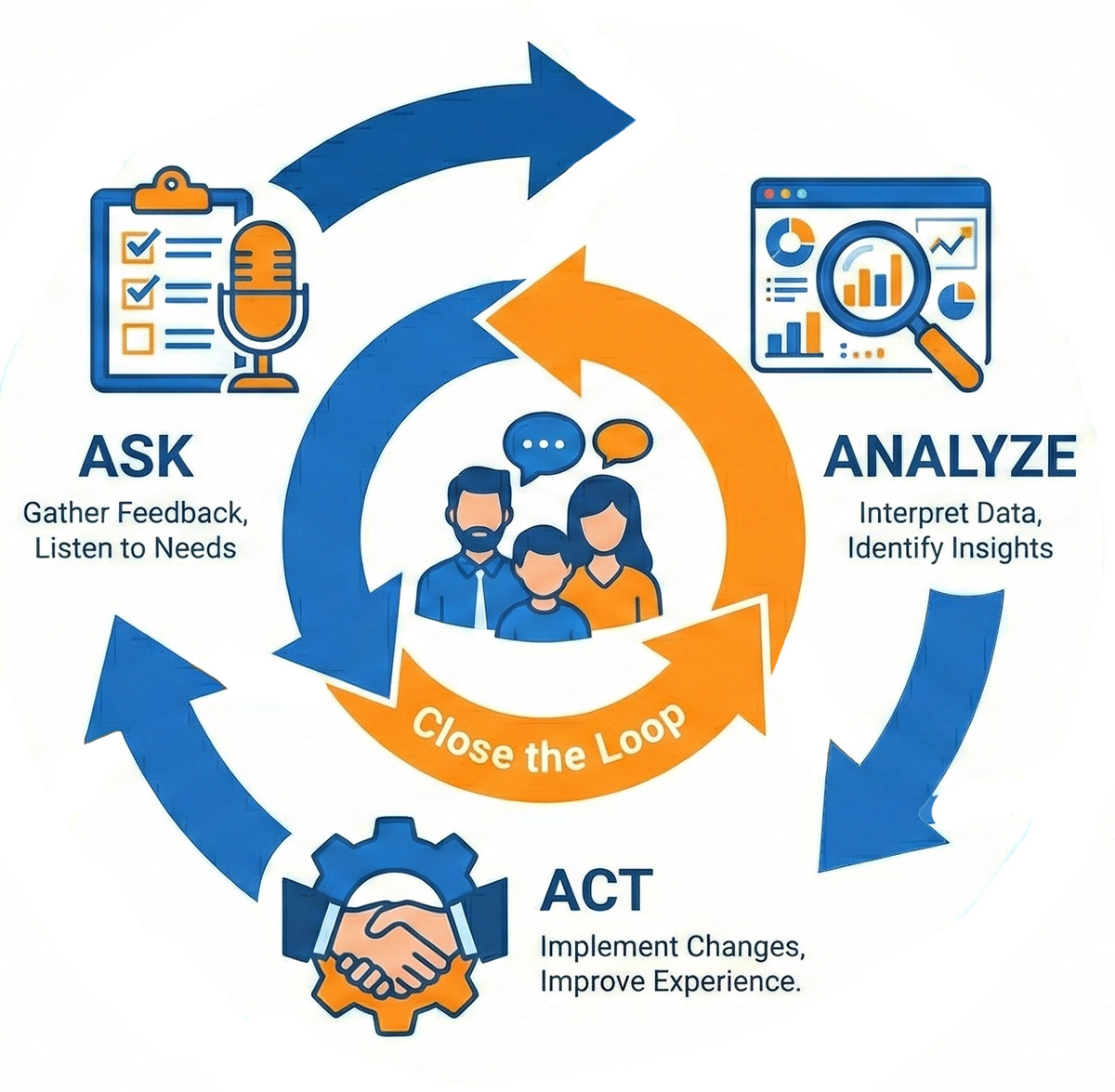
Customer feedback management follows four stages: Collection, Analysis, Action, and Close the Loop. Skipping any one of them is why most programs stall.
Stage 1: Collection
Collection means gathering both solicited and unsolicited feedback. Solicited feedback comes from surveys triggered by business events. Unsolicited feedback includes online reviews, support tickets, and social mentions. Collection must be event-triggered rather than manual. Someone has to set up the trigger, or it doesn't happen.
Stage 2: Analysis
Analysis means organizing raw feedback into patterns you can act on. You categorize by theme, score sentiment, and identify systemic issues. AI-assisted analysis is now standard in feedback tooling. In fact, in December 2024, Gartner found that 85% of customer service leaders planned to pilot customer-facing conversational GenAI in 2025.
Stage 3: Action
Action means routing the right feedback to the right person. It involves making a visible change to a process or product. The stakes are high. Currently, 52% of consumers say they stopped using a brand after a bad experience (source: PwC 2025 Customer Experience Survey). The customer needs to know something changed.
Stage 4: Close the Loop
Closing the loop means following up directly with the person who gave feedback. You tell them what you did or why you couldn't act. This is where most programs die. It requires someone to own the follow-up, and most teams lack that person.
The programs that stall almost always stall between Analysis and Close the Loop. This is where work shifts from collecting data to taking action.
5 Methods for Collecting Customer Feedback
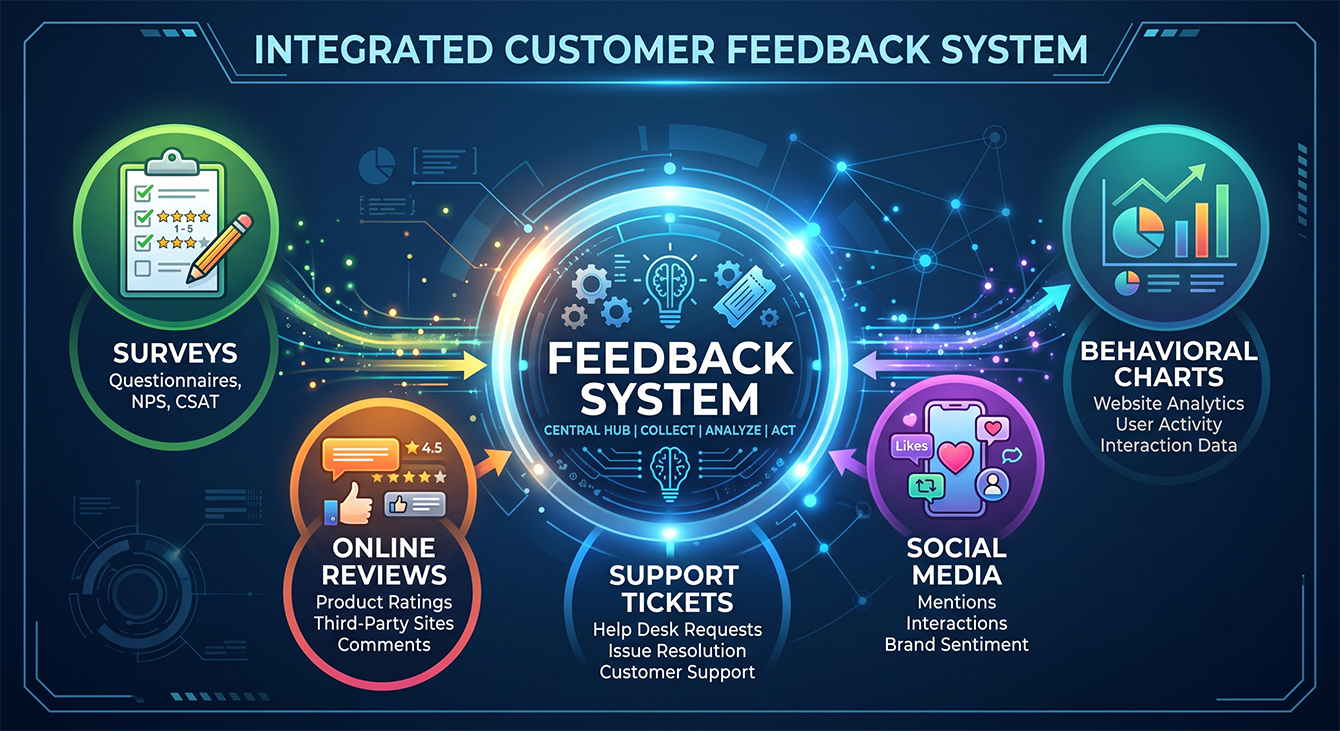
You can collect customer feedback through five primary methods. These are split between solicited feedback and unsolicited feedback.
- Post-transaction surveys: Solicited feedback triggered by a business event and sent via email or SMS.
- Online review monitoring: Unsolicited feedback that arrives on sites like Google and Facebook. Today, 97% of consumers read reviews for local businesses. The average consumer checks six different review sites before choosing one.
- Support ticket analysis: Unsolicited feedback embedded in help desk conversations. Patterns in ticket themes reveal systemic issues that surveys often miss.
- Social listening: Unsolicited feedback on social media and forums. This happens when customers talk about you without tagging you.
- Behavioral signals: Implicit feedback from actions like repeat purchase frequency and engagement drop-offs. These indicate satisfaction or risk without the customer saying a word.
Email-based collection lives or dies on deliverability. Gmail's sender requirements now demand strict SPF/DKIM/DMARC authentication. For bulk senders over 5,000 messages daily, rules demand one-click unsubscribe headers. They also enforce a 0.3% spam-rate ceiling. If your invites don't land, your feedback pipeline dries up.
Most businesses default to one method and miss signals from others. A complete program pulls from at least two or three streams simultaneously.
Closing the Feedback Loop: How to Actually Follow Through
Closing the loop means following up with every customer who gave you feedback. You do this even when you can't fix what they raised. It is the single stage most programs skip due to bandwidth limits.
When You Can Act on the Feedback
First, the customer gives feedback. The feedback is categorized and routed. The responsible person resolves the issue. Finally, someone contacts the customer to explain what changed.
The loop matters more than any single fix. Businesses systematically overestimate loyalty when they aren't hearing from customers. About nine in ten executives say customer loyalty has grown recently. However, only four in ten consumers agree. A working feedback loop closes that perception gap.
When You Can't Act on the Feedback
Not every piece of feedback leads to a change, and that's fine. Silence is the failure. The customer needs to hear that you heard them. Tell them why you can't act or that you are tracking it.
Acknowledgment alone changes behavior. Currently, 80% of consumers are likely to use a business that responds to reviews. Conversely, 42% are unlikely to use one that never replies.
Follow-Up Timing and Automation
Acknowledge negative feedback within 24 hours. Close the loop on resolved issues within 48 to 72 hours. Follow up on public reviews within one business day.
Consumer expectations are moving toward that standard fast. Today, 19% of consumers expect a same-day response to their review. This is triple the share from a year earlier. Additionally, 32% expect a response by the next day.
Automation handles this at scale. A managed program can trigger an alert the moment a negative response arrives. It routes it to the right person without anyone monitoring a dashboard.
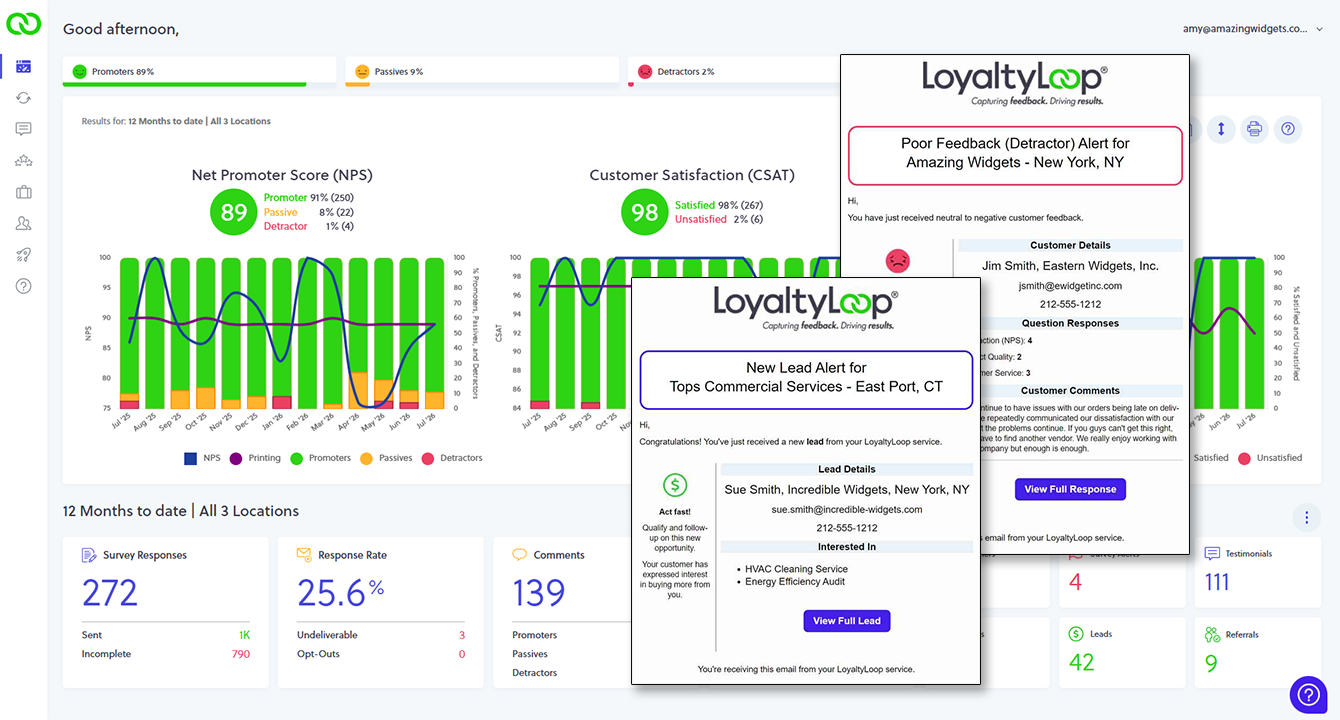
This is why we built the Poor Feedback Alert into LoyaltyLoop®. It fires immediately when a customer responds negatively. The right person knows within minutes.
You should track a simple loop-closure metric. Measure the percentage of negative or neutral responses that received documented follow-ups. Track it monthly. If it falls below 80%, the problem is bandwidth rather than strategy.
Loop-closing is where feedback management becomes a true retention tool. It shows whether a program has an owner or just a dashboard.
Why Feedback Management Matters: 5 Business Outcomes
Feedback management drives five measurable business outcomes. Data shows that businesses running disciplined programs easily outperform their peers.
- Higher customer retention: Customer-obsessed organizations report 51% better customer retention than their peers.
- Reduced churn: Structured feedback programs catch at-risk accounts before they leave. Currently, a PwC survey shows that 29% of consumers stopped buying from a brand due to poor customer experience.
- Product and service improvement: Recurring feedback themes surface the operational fixes that matter most. This turns complaints into a continuous improvement input.
- Reputation growth: Responding to reviews and acting on feedback builds a public review profile.
- Revenue from existing customers: Feedback identifies cross-sell opportunities and reactivates dormant accounts. This turns a backward-looking program into a forward-looking revenue lever.
Feedback connects directly to core management functions. It shapes planning through product roadmaps and quality control through process failures. It manages retention by preventing silent churn. Feedback is an important part of management because it comes directly from paying customers.
These outcomes require acting on feedback and following through. Collection alone produces none of them.
What a Complete Feedback Management System Includes
A complete feedback management system covers eight capabilities. The gap between a basic survey tool and a real system is significant. It usually falls in the last four rows of this table. Use this table to audit a current setup or evaluate a new one.
| Capability | What It Does | What It Enables |
|---|---|---|
| Multi-channel collection | Gathers solicited and unsolicited feedback from surveys, reviews, tickets, and social. | Complete signal coverage instead of one-channel blind spots. |
| Sentiment analysis | Classifies responses as positive, neutral, or negative automatically. | Prioritization: you see the fires first. |
| Survey timing rules | Governs when customers are surveyed based on transaction frequency and configured intervals. | Protects response rates and prevents over-surveying high-frequency customers. |
| Feedback routing and alerts | Sends negative or urgent feedback to the right person in real time. | Faster response and accountability by role or location. |
| Loop-closing workflows | Triggers follow-up tasks and tracks whether the loop was actually closed. | Turns feedback into retention actions, not just data. |
| CRM and system integrations | Connects to existing tools so surveys trigger from business events. Examples include closed professional services automation (PSA) tickets or management information system (MIS) invoices. | Automated collection without manual list uploads. |
| Analytics dashboard | Tracks loyalty, satisfaction, response rates, and trends over time. | Decision-making based on patterns, not anecdotes. |
| Managed vs. self-serve operation | Determines whether your team configures the program or a service provider handles it. | Removes the bandwidth bottleneck that stalls most programs. |
Most tools only cover the first two rows. Programs that work cover all eight, especially timing rules and loop-closing.
How to Measure Feedback Management Success
Track five KPIs to know whether your feedback management program is working. These are loyalty, satisfaction, effort, response rate, and churn. The goal is knowing if customers are happy and if your team acts.
- Net Promoter Score℠ (NPS®): Measures customer loyalty by asking likelihood to recommend on a 0-10 scale. Promoters (9-10) minus Detractors (0-6) equals your NPS. Investigate any quarter where Detractor percentage rises over 5 points. As a licensed Net Promoter System provider, LoyaltyLoop tracks NPS as a continuous-improvement tool rather than a score to chase.
- Customer Satisfaction Score (CSAT): Measures satisfaction with a specific interaction on a 1-5 scale. You should flag any location or service line consistently below 4.0 or 80% CSAT.
- Customer Effort Score (CES): Measures how easy it was for the customer to get issues resolved. A 2025 Deloitte study found companies measuring CES posted the highest customer experience ratings. They scored 4.04 out of 5. Companies measuring nothing posted the lowest at 3.36. Flag any workflow where average CES worsens two survey cycles running.
- Response rate: The percentage of customers who complete your survey. A healthy email survey response rate is 15-30%. Below 10% usually means send timing or list quality needs work.
- Churn rate: The percentage of customers lost over a period. Track this alongside NPS trends. If NPS drops and churn doesn't follow immediately, it will soon.
The same Deloitte study found that analysis cadence matters heavily. Organizations reviewing results daily or within hours score markedly higher on customer experience. Only 6% currently analyze data in real time. A monthly report is a rearview mirror, but daily review is a windshield.
Metrics only matter if someone looks at them regularly and takes action. A dashboard no one checks is identical to having no dashboard.
See How a Managed Feedback Program Actually Runs
Bandwidth is where most programs stall. See how a fully managed service handles configuration, routing, and follow-up so your team doesn't have to.
Feedback Management for Businesses Without Internal Bandwidth
Running a feedback management program requires ongoing operational work. Most programs stall because no one has the bandwidth to own it.
Consider the real operational load of running a program. You must configure survey logic, maintain lists, and monitor daily incoming responses. You have to route negative feedback and follow up with unhappy customers. You must also respond to public reviews and track metrics. Even the data feed itself needs monitoring, as feeds can fail silently. This is a recurring weekly commitment rather than a one-time setup.
When no one owns it, the pattern is predictable. A business sets up surveys, and responses trickle in. No one reviews them consistently, and follow-up completely stops. The program goes dormant within 90 days. The tool still sends, but no one listens. This makes self-serve tools feel expensive. "Easy to use" only matters if someone actually uses it.
A managed feedback program handles this operational work for you. It covers configuration, monitoring, routing, follow-up triggers, and reporting. The business gets outcomes without hiring or carving out weekly owner time. Survey platforms can get acquired or shut down. When yours does, a self-serve program dies with it.
The question isn't whether feedback management works. It's whether you have someone to run it. If not, you must consider letting someone else do it.
Who Runs This? Use Cases by Business Type
How you run feedback management depends heavily on your business model. It also depends on transaction frequency and who your customer is. Here is how four common business types handle it.
-
Service Businesses
A regional HVAC company sends post-service surveys triggered by completed work orders. Within six months, they identify that one technician generates 40% of negative feedback. This pattern was completely invisible in their Google reviews. They retrain the tech and watch their CSAT climb.
-
Franchise and Multi-Location Brands
A 12-location franchise brand uses post-transaction surveys to flag location-level service gaps. They do this before problems ever reach Google reviews. Corporate sees which locations are trending down. They intervene before a pattern becomes a public reputation problem.
-
MSPs and IT Service Companies
An MSP with 30 managed accounts surveys decision-makers quarterly. They do not just survey help desk contacts after tickets. They discover two accounts scoring as Passives are evaluating competitors. They save both accounts with a direct conversation.
-
SMBs and Owner-Operated Businesses
A five-person print company integrates feedback collection with their invoicing system. Surveys go out automatically after posted invoices. The owner doesn't monitor a dashboard. A managed program flags negative responses and routes them to her immediately. She calls the customer back the exact same day.
These businesses kept their feedback programs running by automating the collection. They also ensured someone owned the follow-through.
EFM vs. Customer Feedback Management: What's the Difference?
Enterprise feedback management (EFM) and customer feedback management sound highly interchangeable. However, they describe completely different scopes. This distinction matters when you're evaluating tools.
EFM is a legacy term coined by Gartner analysts in the mid-2000s. It strictly covers survey deployment and data collection. It handles the mechanics of asking questions and storing answers.
Customer feedback management represents a much broader, modern scope. It includes unsolicited signals, multi-channel collection, sentiment analysis, and loop-closing. EFM is simply Stage 1 of the process. Customer feedback management is all four stages working together.
If a tool calls itself "enterprise feedback management," be careful. Check whether it covers analysis, action, and loop-closing, or just survey distribution.
Feedback Is a Management Function That Needs an Owner

Feedback management belongs firmly in operations, alongside quality control and retention. The problems it surfaces are operational problems requiring operational owners. These include service failures, churn risk, and process breakdowns.
The most common failure mode is entirely organizational. Feedback management gets assigned to marketing and treated as a campaign. It is abandoned when the next priority arrives. Feedback is an ongoing management function that feeds core business decisions. Businesses treating it as an operational program retain more customers. They catch problems before they become public.
You face a clear ownership decision. You must assign an internal owner with dedicated weekly time. Alternatively, you can hand the operational work to a managed program. Both approaches work well. Assuming the tool will simply run itself does not work.
Businesses that get the most from feedback management stopped treating it as a project. They started treating it as a function that runs every single week.
Start Managing Customer Feedback with LoyaltyLoop
You now have a framework for collecting feedback, analyzing patterns, and closing the loop. This means you can catch churn risk before it reaches a public review. You can turn feedback into retention instead of just data.
LoyaltyLoop runs your feedback program completely end to end. We handle collection, routing, follow-up, and comprehensive reporting. You do not need to hire someone or add it to a full plate.
Get a Feedback Program That Runs Every Week
The four stages only work when someone owns them. Schedule a demo to see how LoyaltyLoop handles collection, routing, and follow-up, so your program keeps running without anyone on your team watching a dashboard.
Schedule a DemoFAQs About Feedback Management
Q: Do I need to send surveys after every transaction?
A: No. Sending after every transaction annoys high-frequency customers and tanks your response rate. Set business rules that time surveys by transaction frequency. A customer who orders weekly gets surveyed quarterly, while a one-time customer gets surveyed immediately. This is why LoyaltyLoop includes a Touch Frequency Filter. It defaults to no more than one survey request every 90 days per customer.
Q: What's the difference between solicited and unsolicited feedback?
A: Solicited feedback is what a business specifically asks for. This includes surveys triggered by transactions or sent on a schedule. Unsolicited feedback arrives unprompted. This may include online reviews, support tickets, social mentions, and behavioral signals like churn timing. A complete program monitors both streams. Unhappy customers often skip the survey and go straight to the public channel.
Q: What happens if a customer leaves negative feedback?
A: The feedback gets flagged immediately. It is routed to the right person on your team. That person follows up directly with the customer within 24 to 48 hours. They acknowledge the issue and explain what you're doing about it. You must do this even if you can't fix what they raised. Real-time alerts prevent negative feedback from sitting unnoticed.
Q: Can feedback management work for businesses with fewer than 10 employees?
A: Yes. Small businesses are often the best fit for a managed feedback program. They usually lack the bandwidth to run one themselves. A managed program handles configuration, monitoring, routing, and follow-up. The owner gets the retention outcomes without taking on the daily operational work. This removes the burden that normally kills feedback programs at small businesses.
Q: How long does it take to see results from a feedback management program?
A: You will see negative feedback flagged and routed within the first week. Measurable changes in response rate, loyalty trends, and Google review velocity appear within 60 to 90 days. This happens once the program runs consistently. Customers must see that you're acting on what they tell you. Programs that go dormant after 90 days never reach the outcome stage.
Q: What's the difference between a feedback tool and a managed feedback program?
A: A feedback tool gives you software to configure and run yourself. A managed feedback program gives you a team that handles the work for you. They configure surveys, request reviews, route alerts, and track metrics. They also adjust the program as your business changes. You get the outcomes without owning the operational work. Self-serve tools require internal bandwidth to maintain.