
Leveraging Net Promoter Score in Your Business
Section 8: How NPS® Translates to the Bottom Line
You don't know what you don't measure
Last month, in Section 7 of our latest whitepaper we discussed what not to do with NPS. This month, we'll take a look at how NPS affects your bottom line.
So, say you agree at this point that investing in your customer experience is a good idea, but you don't know if you can afford it. How can you be sure that your investment in improvements will pay off? Let's turn to data for some answers.
First, let's visit this London School of Economics Article measuring intangible assets and their effect on stock performance. This study sought to confirm or deny the following statement: "Companies that do better by their customers also do better in the stock market." They conducted a fifteen-year analysis of publicly traded companies in the US and UK, using the American Satisfaction Index (ACSI). They found that "customer satisfaction-based trading generates 'excess' stock returns of about 10% per year."
This Harvard Business Review Study sought to quantify the impact of customer experience. They looked at two types of companies – subscription-based and transaction based – and studied customer feedback as well as future spending by individual customers. The results were clear – customer experience is a large indicator of future revenue.
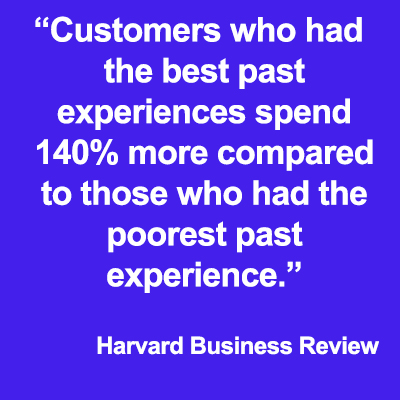
For transaction-based companies, they found that customers who had the best past experiences spend 140% more compared to those who had the poorest past experience." Subscription based companies are more concerned with length of customer retention and upselling, not focusing on individual transactions. For these companies, they found the following relative to subscription customers (aka members), that "on average, a member who gives the lowest score will likely only remain a member for a little over a year. Compare that to a member who gives the highest score — they are likely to remain a member for another six years."
These results are huge for both transactional and subscription-based companies, showing that investing in customer experience does translate to the bottom line. Of course, it is important to remember that just because your customer had a good experience once does not mean they will necessarily always return and that your job is done. Investing in your customers' experience is an ongoing process of improvement, which – if you stick to consistently – will reward your business's bottom line in the long run.
Tune in next month for the FINAL section from our latest whitepaper "Leveraging Net Promoter ScoreSM in Your Business".