
How Google Reviews Drive Local Business Success
For decades, the "front door" of a local business was made of glass and wood. It was the physical entrance where customers formed their first impression. Today, your front door is digital. It is your Google Business Profile.
Before a potential customer ever visits your website or picks up the phone, they likely Google you. What they see in that split second - specifically your star rating and review count - often determines whether they click "Call" or keep scrolling to your competitor.
It is no exaggeration to say that reviews are the currency of the modern local economy. But their value goes far beyond just "looking good." Let’s dive into how Google reviews drive local business success by acting as a dual engine for both visibility (SEO) and conversion (Sales).
The SEO Impact: Cracking the "Map Pack"
Have you ever searched for a service, like "plumber near me" or "coffee shop," and noticed the map that appears at the very top of the results with three specific businesses listed? This is called the "Local Pack," and it is the most valuable real estate on the internet for a local business.
Getting into this pack is the primary goal of Google Business Profile optimization, and reviews are the ticket in.
When determining which businesses to rank in the Local Pack, Google's algorithm looks for specific signals from your reviews:
- Quantity: Do you have enough reviews to be statistically significant?
- Velocity: Are you getting reviews consistently (e.g., one a week vs. ten all at once three years ago)?
- Diversity: Do you have a mix of ratings and detailed feedback?
- Recency: Do you have a steady flow of recent activity from new or updated reviews?
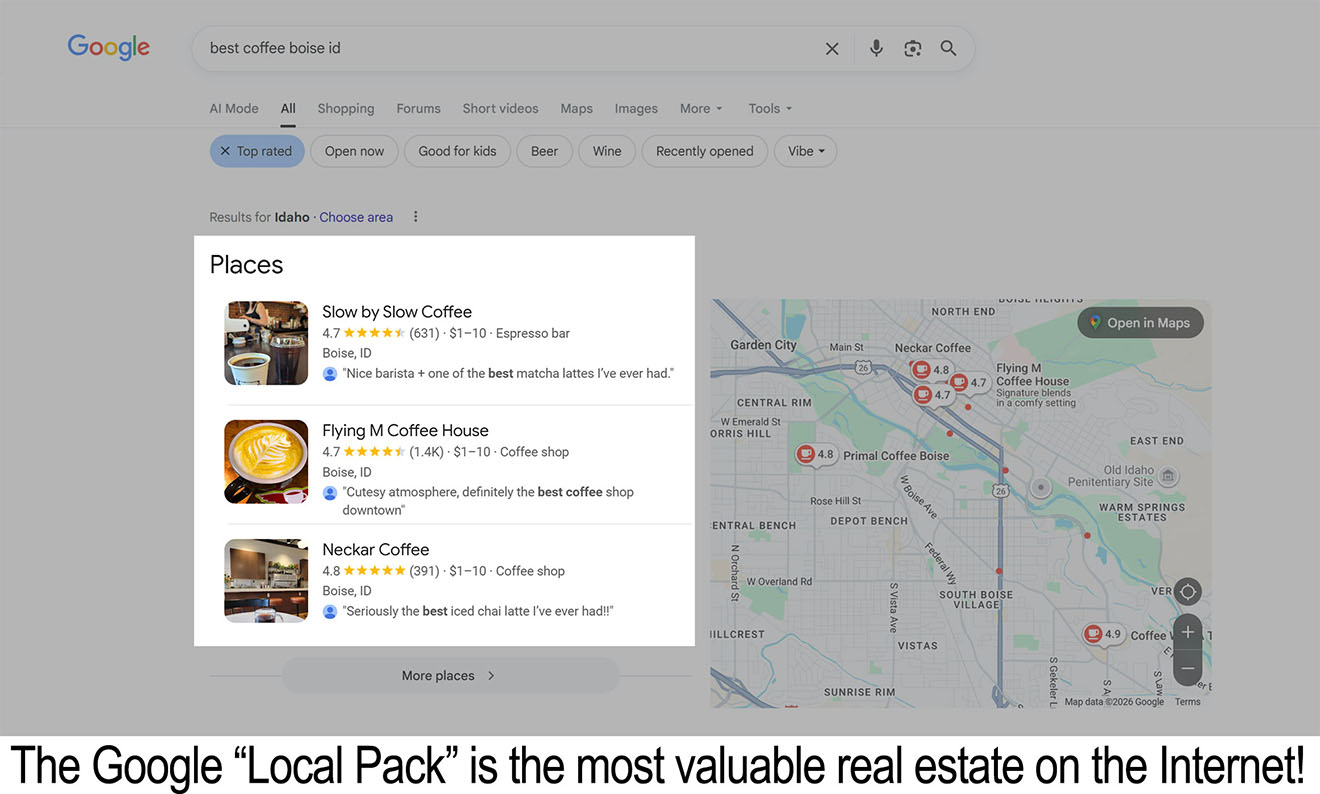
The impact of Google reviews on ranking is massive. Google wants to recommend the "best" and most active business to its users. A steady stream of fresh, positive reviews signals to Google that you are open, active, and trusted by the community.
The Secret Sauce: Keywords Inside Reviews
Here is a lesser-known SEO secret: The words your customers use in their reviews matter just as much as the stars they give you. This is the power of keywords in Google reviews.
Imagine you own a landscaping company. You want to rank for "patio installation," but your business name is just "Smith Landscaping." If a customer writes a review saying, "Smith Landscaping did an amazing job with our patio installation. The pavers look great!", they have just gifted you a powerful SEO keyword association.
Google "reads" these reviews. When it sees customers consistently mentioning specific services (like "oil change," "gluten-free," or "emergency repair"), it becomes more confident in ranking you for those specific search terms. Your customers are literally writing your SEO content for you.
Conversion: Turning Searchers into Customers
Ranking high gets you seen, but reviews get you chosen.
Once a customer finds you, they immediately look for social proof to validate their decision. This is where the psychology of trust comes into play.
- The Volume Factor: A 4.8 rating with 150 reviews is often more powerful than a 5.0 rating with only 2 reviews. The higher volume implies consistency and lowers the perceived risk.
- The Recency Factor: If your last review was from 2021, customers (and Google) might wonder if you are still in business or if your standards have slipped. Consistent, recent activity in the form of new reviews, updated existing reviews, and review replies, signals Google that your business is still active and providing current value.
How Google reviews drive local business success is simple: they remove the fear of the unknown. A detailed, positive review tells a prospect, "Someone else spent money here and was happy, so you will be too."

The Action Plan: Getting and Managing Reviews
Knowing you need reviews is easy. The hard part is actually getting them. If you rely on customers to "remember" to leave a review when they get home, you will be waiting a long time.
Here is how to get more Google reviews consistently:
1. You Must Ask (and Automate)
The #1 reason customers don't leave reviews is simply that they weren't asked. The best time to ask is immediately after the service is delivered. Tools like LoyaltyLoop automate this process, sending a friendly request via email or text right when the customer is happiest.
2. Respond to Everything
Getting the review is only half the battle. You must respond to them.
- For Positive Reviews: A simple "Thank you, [Name]! We loved working with you" shows you appreciate their business.
- For Negative Reviews: Don't panic. A polite, professional response can actually build trust with future customers by showing you care about fixing issues.
Responding to Google reviews examples:
Response to "The Good": "Thanks for the kind words, Sarah! We’re glad we could help get your AC running before the heatwave."
Response to "The Bad": "Hi John, we are sorry to hear you were disappointed. We’d love to make this right - I will be calling personally. If I miss you, feel free to call me directly at [Phone Number] or our manager at [Phone Number]."
Conclusion
Your Google reviews are more than just a vanity metric; they are a 24/7 marketing team that never sleeps. They help you rank higher in search results, provide free SEO keywords, and convince uncertain prospects to choose you over the competition.
Don't leave your online reputation to chance. By implementing a strategy to consistently ask for and respond to reviews, you turn your customer feedback into your most powerful engine for growth.
Ready to automate your success? Manually asking every customer for feedback is exhausting, and easy to forget. LoyaltyLoop automates the entire process, sending friendly, timely review requests the moment your customer is happiest. We help you capture the glowing feedback that drives your SEO rankings and builds instant trust with new leads.
Stop chasing reviews and start growing your business. Schedule a Quick Demo with LoyaltyLoop today.
Schedule a DemoFrequently Asked Questions (FAQs)
Q: How exactly do Google reviews help my local SEO rankings?
A: Google’s algorithm looks for specific signals to determine which businesses to rank in the "Local Pack" (the top three map listings). Specifically, it analyzes the quantity of your reviews, the velocity (how consistently you get new ones), and the diversity of the feedback. A steady stream of fresh reviews signals to Google that your business is active and trusted by the community.
Q: Is it better to have a perfect 5-star rating or a high volume of reviews?
A: Surprisingly, volume often wins. A 4.8 rating with 150 reviews is generally more powerful than a 5.0 rating with only 2 reviews. Higher volume implies consistency, lowers perceived risk for the customer, and provides more data for Google's search algorithms.
Q: Should I really respond to negative reviews?
A: Yes, absolutely. While it might feel uncomfortable, a polite and professional response to a negative review can actually build trust. It shows future customers that you care about their experience and are willing to fix issues when they arise.
Q: How do keywords in reviews impact my visibility?
A: When customers write detailed reviews mentioning specific services (like "patio installation" or "oil change"), they are creating powerful SEO associations for your business. Google "reads" these reviews and becomes more confident in ranking you for those specific search terms, meaning your customers are essentially writing your SEO content for you.